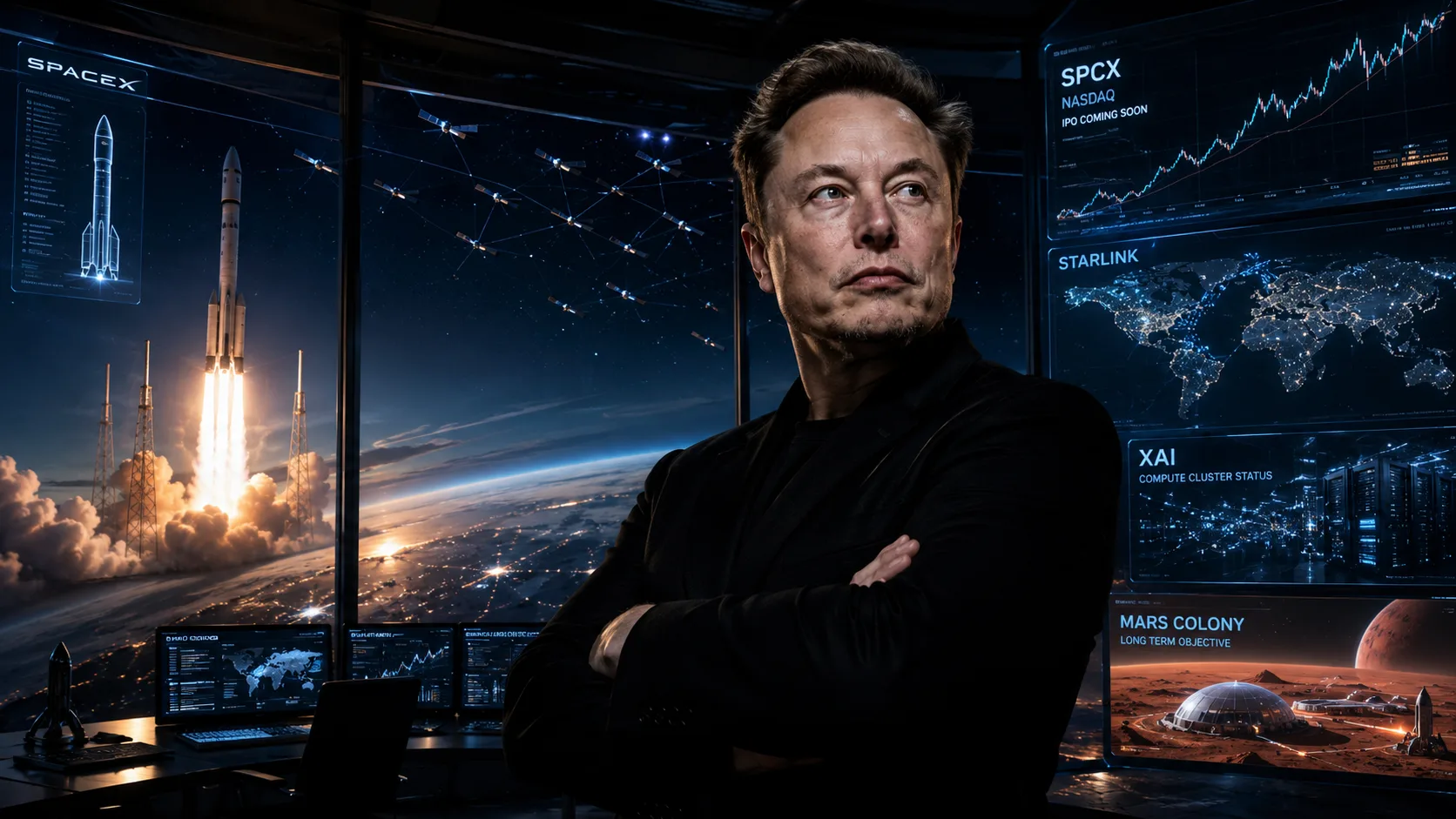
SpaceX’s blockbuster IPO filing revealed a company losing billions, deeply tied to Elon Musk’s sprawling empire, and structured so outside investors have almost no real control. Beneath the excitement surrounding what could become the largest IPO in history sits a much bigger story: Wall Street is entering a new era where capital is chasing narrative dominance over traditional profitability. Investors who understand this shift early may spot the next winners before the broader market fully grasps the consequences.
The Filing Everyone Waited For Finally Arrived
For years, SpaceX existed in a strange financial gray zone. It was arguably the most important private company in America, yet investors had to rely on secondary-market rumors, leaked valuations, and selective interviews to understand what was really happening behind the curtain.
Now the curtain is open.
The filing revealed a company expected to pursue a valuation above $1.5 trillion despite posting staggering losses. SpaceX lost $4.9 billion last year on $18.7 billion in revenue. The first quarter of this year looked even worse, with losses reaching $4.3 billion on only $4.7 billion in revenue.
At first glance, those numbers look alarming, especially compared to the profitability expectations usually attached to mega-cap public companies. But investors looking only at the losses are likely missing the larger strategic transformation taking place underneath the surface.
SpaceX is no longer simply a rocket company.
It is evolving into a vertically integrated infrastructure empire spanning satellite communications, AI computing, defense technology, aerospace logistics, data centers, and potentially the early foundations of off-world industrial systems. That distinction matters because markets tend to reward companies very differently when investors believe they are building infrastructure rather than simply selling products.
Wall Street Is Looking at the Wrong Business
Most headlines surrounding the IPO filing focused on the red ink. That framing is understandable, but it may ultimately prove shortsighted.
The filing effectively confirmed that SpaceX is attempting to become the first true planetary infrastructure company. Its Falcon launch business generated roughly $4.1 billion in revenue last year, while Starlink produced $11.4 billion. Meanwhile, the newly merged xAI division consumed enormous amounts of capital while building out AI infrastructure in an increasingly brutal race against rivals.
Traditional aerospace comparisons no longer fully apply.
SpaceX increasingly resembles a hybrid between Amazon, NVIDIA, Lockheed Martin, and a sovereign communications network. The launch business helps finance orbital dominance. Orbital dominance strengthens Starlink. Starlink expands global data control. Data control feeds AI infrastructure ambitions. AI infrastructure deepens defense and intelligence partnerships.
Those relationships then generate strategic leverage that can finance the next expansion cycle.
That is why traditional valuation models become increasingly difficult to apply here. Investors are being asked to price future control over infrastructure systems rather than near-term earnings power.
The Hidden Story Buried Inside the Filing
The most important revelation was not the financial burn rate.
It was the extraordinary concentration of power surrounding Elon Musk himself.
Musk controls roughly 85% of the company’s voting power through supervoting shares. Public investors may gain economic exposure to the company, but they will have virtually no meaningful influence over leadership decisions or long-term strategy.
That governance structure would once have triggered serious institutional concern. Today, markets increasingly appear willing to tolerate concentrated founder control if investors believe the founder can continue delivering transformational growth.
That represents a major shift in modern capitalism.
For years, public markets pushed corporations toward stronger governance standards, independent boards, and broader shareholder accountability. The SpaceX filing suggests investors may now be moving in the opposite direction, rewarding founder-led empires capable of moving aggressively during periods of technological disruption.
That tradeoff carries real consequences.
If Musk succeeds, shareholders may celebrate the structure because it insulated the company from outside pressure. If execution deteriorates or strategic mistakes emerge, investors could eventually realize they never possessed meaningful leverage to begin with.
The filing removed any illusion about who ultimately controls the company.
The Musk Capital Flywheel Is Becoming Clearer
One of the most revealing aspects of the filing involved the growing interconnectedness between Musk’s companies. SpaceX purchased $131 million worth of Cybertrucks from Tesla and another $506 million in Tesla Megapack energy systems. Meanwhile, xAI paid Tesla roughly $731 million over the past two years.
The companies are also collaborating on AI initiatives and chip manufacturing projects.
Viewed individually, these transactions may look like ordinary strategic partnerships. Viewed collectively, they suggest something much larger is developing: a privately controlled industrial network where Musk-controlled companies increasingly reinforce one another through shared infrastructure, supply relationships, and capital flows.
This creates what could be described as the “Musk Capital Flywheel.”
Capital raised by one Musk company helps fund infrastructure development. That infrastructure then supports another Musk company, which generates additional revenue inside the ecosystem. Higher valuations create more financing capacity, allowing the cycle to continue accelerating.
Investors should pay close attention to this model because it may not remain unique to Musk for long. Other founder-led companies could attempt to replicate similar ecosystems around AI infrastructure, robotics, energy systems, or communications networks.
The traditional conglomerate may be returning in a far more technologically integrated form.
Why Markets Keep Rewarding Massive Losses
Traditional valuation logic struggles to explain why investors continue supporting companies with weak current profitability. Yet the broader market environment increasingly rewards infrastructure dominance over near-term earnings.
That dynamic did not begin with SpaceX.
Amazon spent years convincing investors to prioritize future dominance over present margins. The AI boom accelerated that mindset dramatically as investors poured money into data centers, chips, and cloud infrastructure despite enormous upfront costs.
Now the same psychology is extending into aerospace and orbital communications.
SpaceX reported roughly $20.7 billion in capital expenditures last year, with xAI accounting for a substantial portion of the spending. Traditional value investors may see dangerous excess in those numbers. Growth-oriented investors increasingly see a race to control the foundational systems future industries will depend upon.
That distinction matters.
The companies controlling launch infrastructure, satellite communications, AI compute capacity, and secure data networks may eventually possess extraordinary pricing power. Markets understand that possibility, which explains why profitability is temporarily taking a back seat to strategic positioning.
Washington’s Dependence on SpaceX Could Grow Much Larger
Roughly 20% of SpaceX revenue came from U.S. government agencies last year, including NASA, the Pentagon, and intelligence organizations.
That relationship may become increasingly important over the next decade.
SpaceX is technically a private enterprise, but operationally it is becoming deeply integrated into America’s national security infrastructure. The company works with the National Reconnaissance Office on classified satellite systems and plays a growing role in military and intelligence communications.
This creates a powerful strategic advantage.
As geopolitical tensions intensify with countries like China, Washington is likely to rely more heavily on private technology operators capable of deploying advanced systems rapidly. Investors should expect a larger percentage of future defense spending to flow toward dual-use technology companies rather than exclusively toward traditional military contractors.
That shift could reshape aerospace, cybersecurity, communications infrastructure, and AI markets simultaneously.
The Contrarian Angle Most Investors Are Missing
Many investors will view the SpaceX IPO as another example of speculative excess driven by hype surrounding Elon Musk and artificial intelligence.
There is certainly some truth in that concern.
However, the larger structural shift may be that physical infrastructure is becoming strategically scarce again after decades where software-driven scalability dominated market thinking. The AI race has changed the equation because AI systems require enormous real-world infrastructure including power generation, cooling systems, semiconductors, data centers, transmission networks, and satellite connectivity.
Physical assets are becoming strategically valuable again.
SpaceX sits directly in the middle of that transition because it touches launch systems, communications infrastructure, defense technology, and AI compute simultaneously. Investors focusing exclusively on software businesses may be overlooking where the next concentration of economic power is forming.
The biggest winners of the next decade may emerge from industries tied to energy infrastructure, semiconductor manufacturing, aerospace logistics, industrial automation, and large-scale compute systems.
The filing may ultimately represent the symbolic turning point where markets fully pivoted back toward hard infrastructure.
The Mars Compensation Package Says More Than People Realize
One of the most surreal details in the filing involved Musk’s compensation structure. One award vests if SpaceX establishes a permanent human colony on Mars with at least one million inhabitants while also achieving massive market-cap milestones.
That sounds absurd on the surface.
Yet the structure reveals something important about how modern markets increasingly operate. Traditional corporations usually tie compensation to earnings growth, free cash flow, or operational targets. SpaceX tied compensation to civilizational ambition.
That distinction matters psychologically.
Markets increasingly reward companies capable of attracting belief, talent, political influence, and long-term investor loyalty around grand missions. Narrative power itself has become a competitive advantage.
The companies capable of convincing investors they are building the future often gain financing advantages that competitors struggle to match. SpaceX may become one of the defining examples of that dynamic.
The Industries Positioned to Benefit
Aerospace and Defense Infrastructure
Traditional defense contractors may face mounting competition from private technology operators capable of moving faster and integrating AI more effectively into military systems. Companies tied to satellite infrastructure, secure communications, and advanced aerospace manufacturing could benefit significantly.
Energy and Grid Expansion
AI infrastructure growth is creating enormous pressure on electricity demand. Utilities, nuclear energy firms, grid modernization companies, and energy storage providers may see growing tailwinds if AI and orbital infrastructure expansion accelerates.
Semiconductor Ecosystems
The filing reinforced how dependent the AI race has become on advanced chip manufacturing and compute infrastructure. Semiconductor equipment firms, cooling-system suppliers, and fabrication leaders remain central to this broader trend.
Communications Networks
Starlink’s growth suggests the future communications battle may increasingly move into orbit. Satellite-based connectivity could become strategically critical for governments, corporations, and military systems alike.
Founder Control Is Becoming a Market Premium
One overlooked implication of the filing involves how much value markets now appear willing to assign to centralized founder authority.
Musk’s voting control effectively prevents shareholder revolts or activist interventions. Ironically, many investors may increasingly view that concentration of power as a strength during periods of technological upheaval because founder-led companies often move faster than consensus-driven corporations.
Markets are beginning to prioritize speed.
That could have major implications for future IPOs, particularly in AI, robotics, energy infrastructure, and advanced technology sectors. If SpaceX performs well publicly despite governance concerns, other founders may pursue similarly aggressive control structures.
The era of broad shareholder influence may weaken further if markets continue rewarding centralized execution.
The Signals Investors Should Watch Closely
Several developments now deserve close attention.
First, investors should monitor how aggressively public markets price the IPO relative to revenue growth and losses. If the valuation remains elevated despite the financial burn, it confirms that infrastructure dominance narratives still hold enormous power over institutional capital.
Second, watch whether governance concerns fade quickly after the IPO. If institutional investors largely ignore the voting structure, it signals markets are fully embracing founder-control models during periods of disruption.
Third, monitor competitive responses across satellite communications, defense AI, semiconductor infrastructure, and orbital systems. SpaceX’s scale may force rivals into aggressive spending cycles of their own.
Finally, investors should pay close attention to energy demand forecasts tied to AI infrastructure growth. The race for compute capacity is rapidly becoming an energy story as much as a technology story.
Bottom Line
The SpaceX IPO filing was never simply about rockets, satellites, or even Elon Musk himself.
It exposed the emergence of a new corporate model where AI infrastructure, communications systems, aerospace logistics, energy networks, and founder control increasingly merge into tightly integrated economic ecosystems. Investors focusing only on quarterly losses may completely miss the larger structural transition underway.
Markets are beginning to reward companies that control foundational systems rather than companies optimized purely for near-term profitability.
That creates enormous opportunities for investors positioned correctly.
It also creates significant danger because markets driven heavily by ambition and narrative eventually test the limits of investor patience. The next decade will likely produce extraordinary winners in infrastructure, AI, energy, and communications systems, but it will also expose which companies possess real strategic durability and which relied primarily on market storytelling.
The investors who thrive will probably be the ones capable of separating infrastructure dominance from financial illusion before the broader market catches up.
About Author