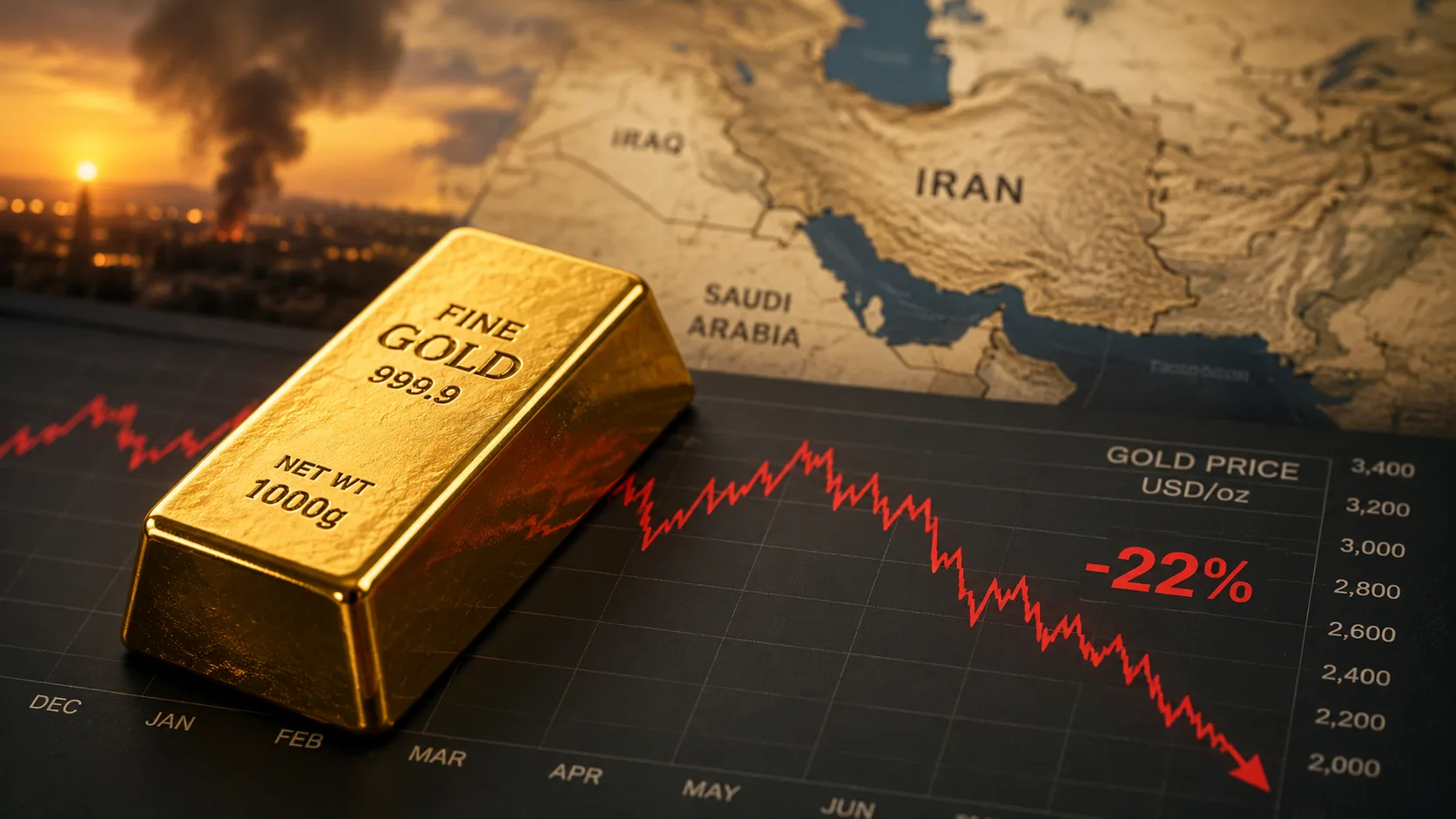
Gold has surprised investors in recent months by moving lower even as conflict in the Middle East intensified. Since the latest Iran conflict began, the precious metal has declined roughly 22%, leaving many investors questioning whether gold has lost its appeal as a traditional safe-haven asset.
Yet beneath the recent weakness, several long-term factors continue to support the investment case for gold. With central banks still accumulating reserves, uncertainty surrounding Federal Reserve policy, and geopolitical risks remaining elevated, some analysts believe the recent selloff may represent a buying opportunity rather than the end of gold’s bull market.
Why Has Gold Fallen During a Geopolitical Crisis?
Normally, geopolitical conflicts push investors toward defensive assets such as gold. This time has been different.
The primary reason appears to be changing expectations for U.S. interest rates.
Markets increasingly believe the Federal Reserve could keep interest rates higher for longer, or even raise rates further, if rising energy prices fuel another wave of inflation. Higher interest rates typically weigh on gold because the metal does not generate income, making interest-bearing assets relatively more attractive.
Gold historically performs best when real interest rates, or interest rates after inflation, are falling.
Adding to the pressure are reports that some central banks in the Middle East may have sold portions of their gold reserves during the conflict to raise liquidity.
While rumors have circulated about additional sales, the largest confirmed transaction came from Turkey, whose central bank sold approximately 81 metric tons of gold during the first half of the year according to the World Gold Council.
Gold Is Still Beating Stocks Over the Past Year
Despite the recent correction, the longer-term picture remains considerably stronger.
Gold is still up approximately 21% over the past 12 months, slightly outperforming the S&P 500 during the same period.
That performance illustrates how quickly sentiment has shifted. Investors have largely focused on the recent decline while overlooking the substantial gains that preceded it.
Corrections following strong rallies are common across virtually every asset class, including commodities.
Central Banks Continue to Support Long-Term Demand
One of the strongest bullish arguments for gold remains intact.
Global central banks continue purchasing gold at historically elevated levels as governments seek to diversify reserves away from the U.S. dollar and reduce geopolitical exposure.
The trend accelerated following Russia’s invasion of Ukraine in 2022 and has remained remarkably strong ever since.
While countries such as China have received much of the attention, European nations have also been major buyers.
According to the World Gold Council, Poland was the largest net purchaser of gold during the first half of the year, highlighting that demand extends well beyond countries seeking to avoid Western sanctions.
Strong official-sector buying provides an important long-term foundation for gold prices, even if short-term market sentiment remains volatile.
Federal Reserve Policy Could Shift Quickly
Much of gold’s near-term outlook depends on the Federal Reserve.
Markets remain divided over whether policymakers will continue fighting inflation with tighter monetary policy or eventually pivot toward supporting economic growth.
The uncertainty has only increased under Fed Chair Kevin Warsh, whose policy approach has offered fewer forward-looking signals than previous Federal Reserve leadership.
If inflation remains elevated because of higher oil prices while economic growth begins slowing, policymakers could face a difficult balancing act.
Several scenarios could ultimately benefit gold:
- Inflation remains stubborn while real interest rates fall.
- Economic growth slows enough to force future rate cuts.
- AI-driven investment spending loses momentum, increasing recession concerns.
- Geopolitical tensions continue disrupting energy markets.
Any combination of those outcomes could improve gold’s outlook over the medium term.
Investors May Be Underestimating Geopolitical Risk
Another reason some analysts remain constructive on gold is investor sentiment itself.
U.S. equities have continued climbing despite ongoing military tensions involving Iran and continued uncertainty surrounding global energy supplies.
That resilience suggests many investors remain focused on artificial intelligence, corporate earnings, and economic growth while assigning relatively little probability to a major geopolitical shock.
Historically, periods of elevated market optimism have often been accompanied by increased demand for portfolio hedges once unexpected events occur.
Gold has traditionally served that role.
What Investors Should Watch
Although gold has endured a sharp pullback, the factors that have supported the metal over the past several years have not disappeared.
Central bank demand remains historically strong, geopolitical uncertainty continues to simmer, and the Federal Reserve’s policy path remains far from certain.
If real interest rates begin falling or inflation proves more persistent than expected, gold could regain momentum.
For long-term investors seeking diversification, the recent correction may offer an opportunity to increase exposure at lower prices rather than a signal to abandon the asset altogether.
About Author