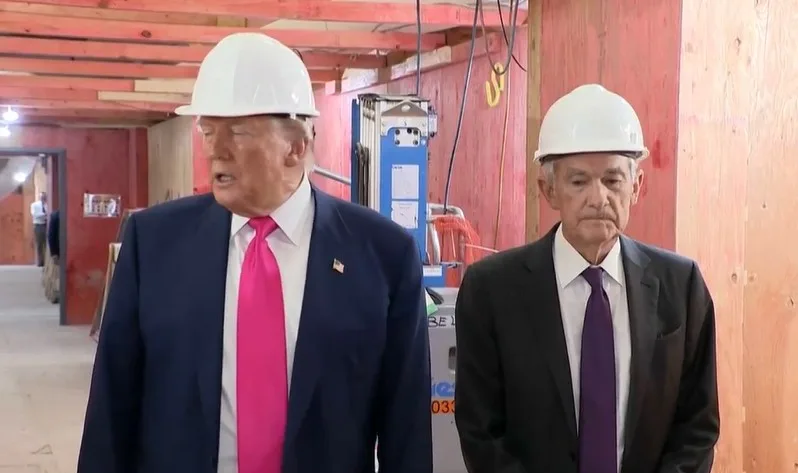
In a highly scrutinized visit that sent ripples through Washington and Wall Street alike, President Donald Trump toured the Federal Reserve’s headquarters on July 24, 2025, for a face-to-face meeting with Fed Chair Jerome Powell. The meeting — Trump’s first as sitting president inside the Marriner S. Eccles Building — marks an unprecedented moment in modern U.S. monetary politics. While the president publicly downplayed any intent to fire Powell, the subtext was clear: pressure is mounting for the Fed to cut rates, rein in spending, and align more closely with Trump’s economic agenda.
Key Takeaways from Trump’s Federal Reserve Visit
1. Trump Says Powell Is Safe — For Now
Despite months of open criticism and even reportedly drafting a letter to fire Powell earlier this year, Trump struck a less combative tone during the visit. “We have no reason to do anything,” Trump said when asked if he would remove the Fed chair. “I think he’s going to do the right thing.”
Still, Powell’s term doesn’t expire until May 2026, and this meeting served as a clear reminder that Trump is watching — and waiting. The reassurance came with an implicit threat: align with the White House, or risk being replaced.
Investor Takeaway: Expect Fed policy to remain in the political spotlight, especially around interest rate decisions. Market confidence in central bank independence may be tested through 2025 and into the election year.
📊 According to CME Group’s FedWatch Tool, futures markets currently price in a 67% chance of a rate cut at the Fed’s September 2025 meeting — up from 42% before Trump’s visit.
2. Dispute Over Fed Renovation Costs
The meeting turned contentious when Trump criticized the ongoing renovation of the Fed’s headquarters, accusing Powell of overseeing “out-of-control” spending. “This building cost $3.1 billion. It was supposed to cost less than $1 billion,” Trump claimed.
Powell quickly pushed back: “It’s not new,” referring to the fact that the $3.1 billion figure includes multiple buildings and phases of the project, not just the primary headquarters.
Trump wasn’t convinced. “That’s the number I’ve seen,” he insisted, adding that he still wants the renovation completed despite calling it “ridiculous.”
Investor Takeaway: The renovation debate may sound trivial, but it signals a deeper concern: Trump is building a narrative around wasteful Fed spending to justify future structural or leadership changes.
The Fed’s original 2017 budget for the Eccles Building renovation was $1.9 billion. Inflation and scope expansions have pushed the latest estimates to $2.5 billion–$3.1 billion, according to Time Magazine.
3. “No Tension,” But All Eyes on Interest Rates
When pressed about his relationship with Powell, Trump claimed, “There’s no tension.” Yet the president renewed his calls for aggressive rate cuts, arguing that lowering interest rates would reduce housing costs, federal debt servicing, and economic friction.
“Rates are too high. They should be 3% lower. We’re wasting $1 trillion a year,” Trump said — a statement economists swiftly criticized as exaggerated.
Powell, meanwhile, reiterated the Fed’s commitment to data-driven policy, noting that inflation, though cooling, still warrants caution.
Investor Takeaway: Trump’s rate demands contradict Powell’s more measured stance. The divergence could lead to increased market volatility — particularly in fixed income and housing sectors — if investors begin to expect politically motivated rate shifts.
The yield on the 10-year Treasury note dipped 6 basis points following the visit, suggesting markets are beginning to price in heightened rate cut risk.
4. Succession Signaling: Powell’s Seat Is in Play
Though Powell has nearly a year left on his term, Trump’s behavior signals that the replacement process is already underway behind closed doors. Names floated by conservative think tanks and Trump allies include Judy Shelton — a former Trump Fed nominee known for her gold-standard leanings — and Kevin Warsh, a former Fed governor and market hawk.
If Powell does not toe the line or if markets wobble heading into 2026, Trump could use policy divergence or even the renovation saga as pretext for early dismissal efforts — legally murky, but not unthinkable.
Investor Takeaway: Investors should start pricing in scenarios where Powell is replaced by a more dovish, Trump-aligned figure. That could introduce significant monetary easing risk — especially ahead of the 2026 election season.
📊 Fed Spending and Rate Pressure in Context
Here’s how the Fed’s renovation spending and the federal interest burden compare:
| Category | Estimated Cost | Notes |
|---|---|---|
| Fed HQ Renovation | $2.5B – $3.1B | Includes upgrades to Eccles Building, plus two additional facilities |
| Annual Interest on U.S. Debt | ~$1.2 Trillion (2025 est.) | Projected under current interest rate trajectory |
| Trump’s Proposed Rate Cut | 300 basis points | Would reduce debt service by ~$700B–$900B annually (per CBO simulations) |
Source: CBO, Time, Fox Business
Can a President Fire a Fed Chair?
Technically, no — at least not easily. Federal Reserve chairs are appointed for four-year terms and can only be removed “for cause,” which typically means gross misconduct, not policy disagreements. But legal gray areas remain. Past presidents have clashed with Fed chairs — from Nixon to Reagan — but none have removed one.
Earlier this year, reports from the Wall Street Journal and Business Insider suggested Trump drafted a letter to fire Powell, but was advised against it due to legal and market consequences.
Investor Takeaway: Even if Powell stays, his independence may be compromised. That’s a bearish signal for long-term Treasury holders and could weaken the dollar if global markets perceive the Fed as politically compromised.
What to Watch Next
- Fed Meeting Minutes (August 2025): Analysts will comb through for hints of internal Fed dissent or political pressure.
- White House Economic Council Statements: Any change in tone could indicate preparation for a Fed shake-up.
- Market Sentiment: Expect bond market volatility and potential safe-haven rotation if Trump escalates attacks.
- Powell’s Public Appearances: Investors will watch whether he doubles down on independence or signals compromise.
Institutional Trust vs. Political Power
Trump’s visit to the Fed wasn’t just symbolic. It was a warning shot. By openly challenging the renovation budget, demanding rate cuts, and holding Powell publicly accountable, Trump is asserting dominance over an institution that has, until now, operated with political insulation.
For investors, the risks are clear: Fed independence is no longer guaranteed. Policy could tilt more political, more unpredictable, and potentially more inflationary.
At the same time, markets have seen this movie before — and often, they like it. Rate cuts juice equities, lower the cost of capital, and lift risk assets. But if those cuts are driven by politics rather than fundamentals, the eventual hangover could be severe.
Investor Bottom Line: Position for rate volatility, inflation asymmetry, and a potential shift in Fed leadership. Long-duration bonds and dollar-denominated assets may become more vulnerable in this new era of politicized monetary policy.
Sources:
- Fox Business – Four Key Takeaways from Trump’s Fed Visit
- Time Magazine – Trump Draws Attention to Fed Renovation
- Business Insider – Trump and Powell Clash on Numbers
- WSJ – Trump Visits Fed as Tensions Rise
About Author