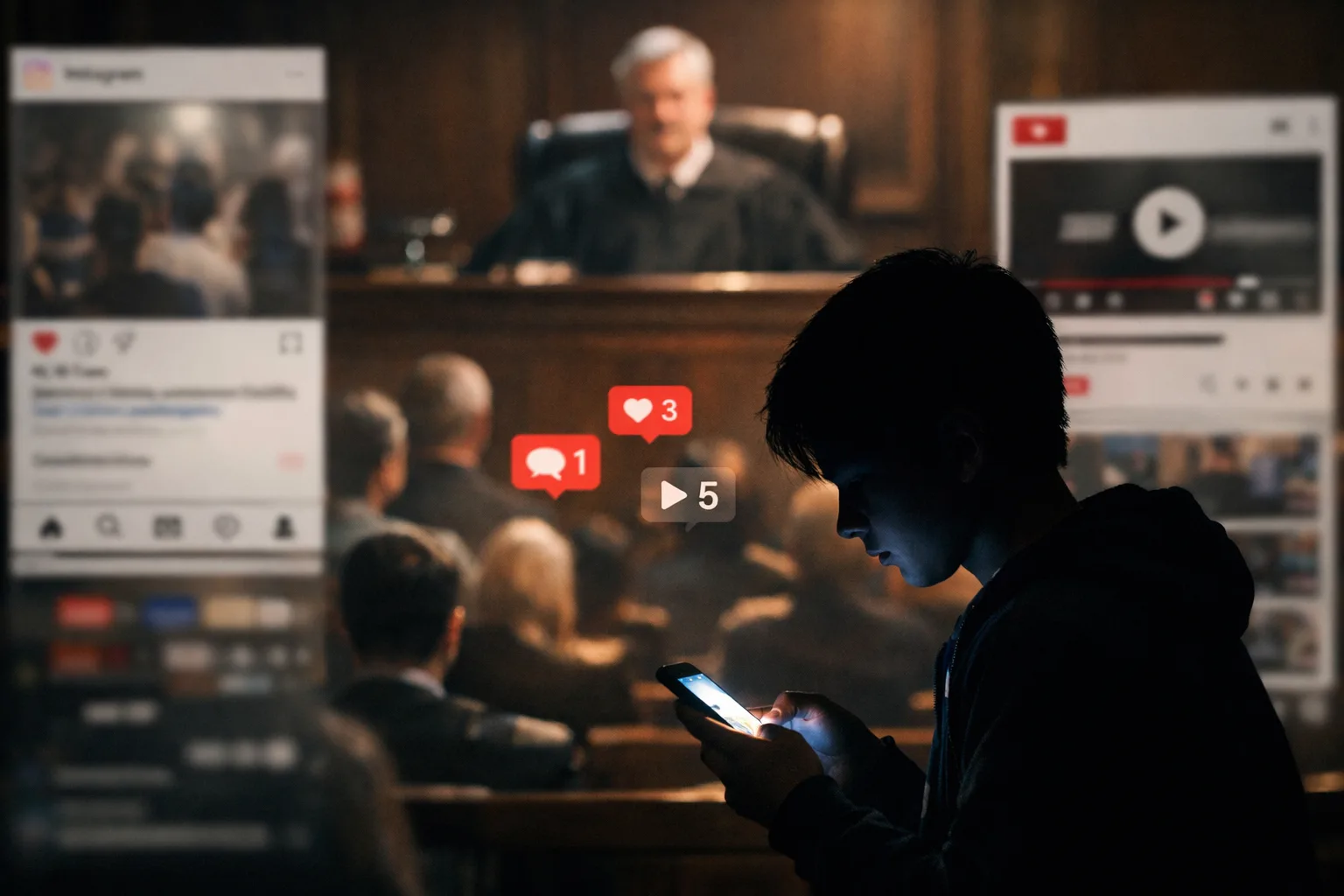
A closely watched courtroom battle is underway in Los Angeles that could reshape the future of social media, youth safety, and Big Tech liability. Lawyers representing a now-20-year-old woman are preparing to argue that major technology platforms knowingly designed addictive systems that harmed her mental health, in what legal observers are calling one of the most important social media trials ever to reach a jury.
The case centers on a plaintiff identified by her initials, KGM, who alleges that prolonged exposure to Instagram and YouTube during her childhood led to severe psychological harm. Her legal team claims the platforms intentionally engineered features to maximize engagement, even when those features negatively impacted young users.
If the jury sides with the plaintiff, the consequences could ripple across the technology sector, influencing roughly 1,500 similar lawsuits currently pending against major social media companies. Legal analysts say potential damages could reach billions of dollars and may force meaningful changes in how platforms design their products, especially for minors.
The Core Allegations
At the heart of the case is the claim that Instagram and YouTube built systems designed to keep users engaged for as long as possible, creating what the plaintiff’s attorneys describe as a harmful feedback loop.
“I think that we will be able to show you evidence that indicates Instagram and YouTube created certain design features … to keep young users like (KGM) engaged for as long as possible,” KGM’s lawyer Mark Lanier said during jury selection. “She became consumed by these platforms; her mental health declined. Her childhood, hence her adulthood, deviated from a normal path.”
According to the lawsuit, KGM began using YouTube at age six and Instagram at age nine. At times, attorneys claim she spent six to seven hours per day on YouTube and several hours daily on Instagram, even after her mother attempted to restrict access using blocking software.
The complaint states that platform features such as infinite scrolling feeds, frequent notifications, and appearance-altering filters contributed to worsening mental health conditions. The lawsuit alleges she developed anxiety, body dysmorphia, and suicidal thoughts during her years of heavy usage.
The plaintiff also claims she encountered bullying and sextortion on Instagram, a form of online exploitation in which bad actors threaten to release private images unless victims send money or more content.
The Defense Strategy
Lawyers representing Meta and YouTube have rejected the claims and are expected to argue that the plaintiff’s struggles were caused by factors unrelated to social media.
Defense attorneys plan to point to a difficult family environment as a more likely contributor to her mental health challenges. During jury selection, they suggested parental control could have prevented excessive use, noting that the plaintiff’s mother could have removed access to the platforms.
Technology companies have long denied that their products are inherently harmful and say they continue investing in safety features for young users.
A Meta spokesperson stated, “we strongly disagree with these allegations and are confident the evidence will show our longstanding commitment to supporting young people.”
A YouTube spokesperson echoed that stance, saying the lawsuit’s claims are “simply not true” and that “providing young people with a safer, healthier experience has always been core to our work.”
Broader Context and Industry Pressure
This trial is unfolding amid rising global scrutiny of social media’s impact on children and teenagers. Policymakers, parents, and mental health professionals have increasingly questioned whether algorithm-driven engagement models contribute to anxiety, depression, and behavioral addiction among young users.
Over the past several years, social media companies have introduced various safeguards including screen time reminders, parental controls, content filtering, and break notifications. Critics argue these tools are insufficient and do not address the core design incentives driving engagement.
Executives expected to testify in the coming weeks include Meta CEO Mark Zuckerberg, Instagram head Adam Mosseri, and YouTube CEO Neal Mohan. Their testimony could provide rare insight into internal decision-making and platform design strategies.
Meanwhile, other companies have already sought to reduce legal exposure. Snap and TikTok, which were also named in the lawsuit, reached settlements before trial but remain defendants in other pending cases nationwide.
The Legal Stakes
Legal experts say the outcome could establish an important precedent for how courts evaluate platform responsibility for user behavior and mental health outcomes.
If the plaintiff prevails, technology companies may face increased liability tied to product design, particularly features that encourage prolonged use among minors. That could trigger stricter regulations, mandatory safety design changes, and potentially large financial settlements across hundreds of cases.
On the other hand, a defense victory could reinforce current legal protections for platforms, including arguments centered on parental responsibility and the complexity of mental health causation.
Public Sentiment and Jury Dynamics
Jury selection revealed a wide spectrum of opinions about social media’s influence. Some prospective jurors expressed deep concern about its impact on children and society, while others emphasized parental responsibility in monitoring usage.
Members of the final jury panel will be allowed to continue using social media during the trial, but the judge has instructed them not to research the case or change their account settings to evaluate arguments presented in court.
Outside the courthouse, parents and advocacy groups have gathered, framing the case as a pivotal moment for accountability in the digital age. Some families say the trial represents long overdue scrutiny of platforms that dominate young people’s daily lives.
What Comes Next
Opening statements were briefly delayed after a health issue involving a Meta attorney, but proceedings are now moving forward. The trial is expected to stretch for several weeks, with testimony from executives, mental health experts, and technical specialists.
Regardless of the outcome, the case is likely to intensify the ongoing debate over whether social media companies should be treated more like product manufacturers responsible for design risks, rather than neutral platforms.
For the tech industry, the trial represents more than a single lawsuit. It is a test of whether engagement-driven digital ecosystems can coexist with growing demands for user safety, transparency, and accountability.
About Author