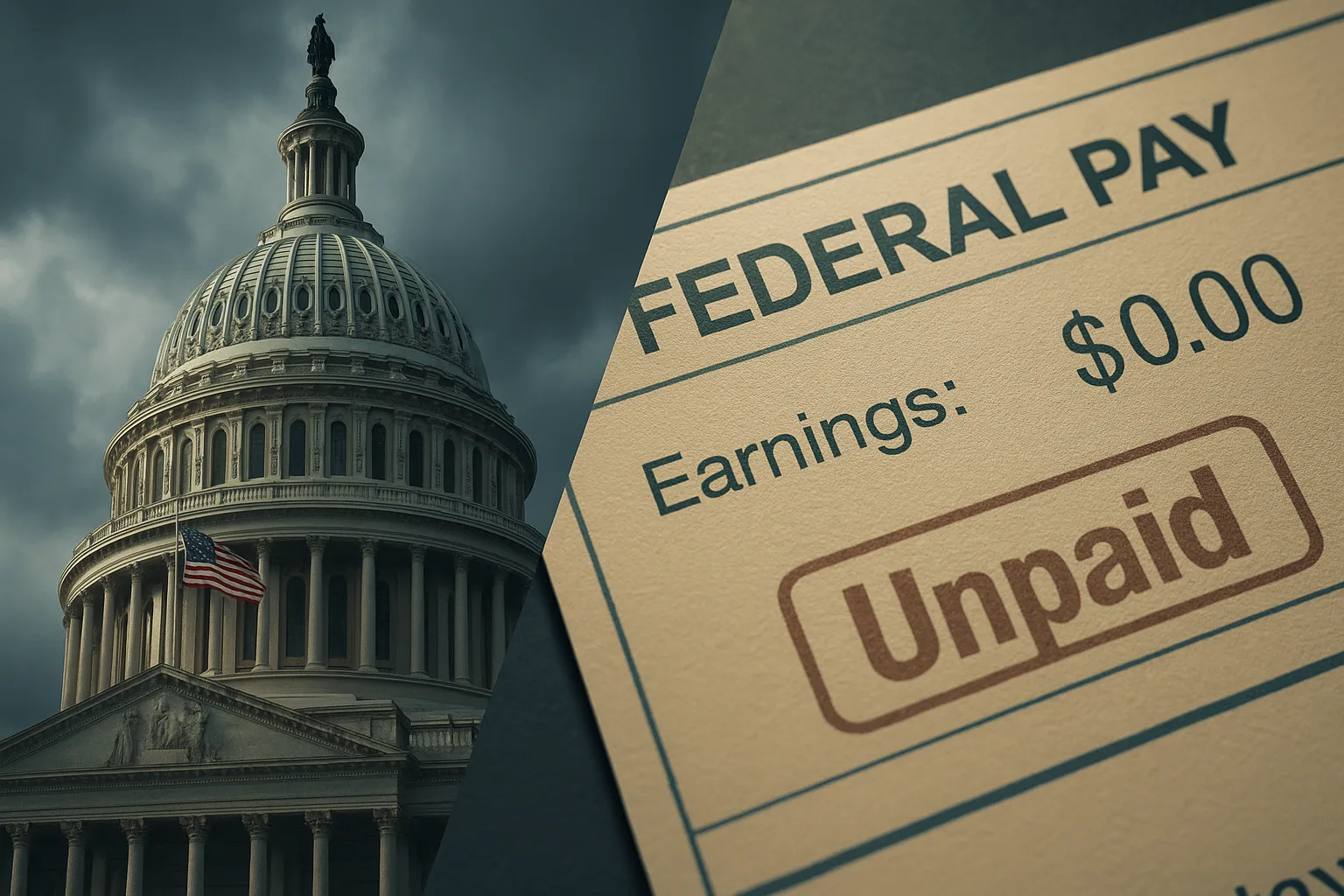
Both Senate Democrats and Republicans are pushing competing bills to pay federal workers during the ongoing government shutdown. But political division in Congress means neither proposal has much chance of becoming law.
Roughly 1.7 million federal employees have been affected by the shutdown. Around 700,000 have been furloughed without pay, while another one million continue to work without paychecks. Each day that passes adds more pressure on households, agency operations, and the broader economy.
With each side blaming the other, the situation is turning into a case study of Washington gridlock. For investors, the longer the impasse drags on, the greater the risk of economic ripple effects on consumer spending, contract payments, and defense supply chains.
Competing Bills, Same Outcome
Republicans and Democrats in the Senate have both introduced bills aimed at ensuring federal employees get paid during the shutdown. But the proposals reflect two very different political approaches.
The Republican proposal, sponsored by Senator Ron Johnson of Minnesota, would continue paying federal employees who remain on the job, along with certain federal contractors who support those operations.
In contrast, the Democratic bill, led by Senators Chris Van Hollen of Maryland and Gary Peters of Michigan, seeks to pay all federal workers regardless of whether they are furloughed or actively working.
Both measures are unlikely to advance because neither side supports the other’s approach. Without 60 votes to overcome a filibuster, both proposals are effectively stalled before even reaching a floor vote.
Democrats Say GOP Plan Favors Trump
Democrats argue that the Republican bill gives too much discretion to the Trump administration over which workers receive pay.
“It’s not legislation that I support because it appears to be more like a political ploy to pick and choose, giving Donald Trump discretion which employees should be compensated and which should not be compensated,” House Minority Leader Hakeem Jeffries said. “All employees should be compensated.”
The Biden-era shutdowns of 2018 and 2019 led to similar political fights over selective pay, which Democrats say should have ended after Congress passed laws guaranteeing back pay for federal employees once shutdowns conclude.
However, a recent draft memo from the Office of Management and Budget suggests furloughed employees are not automatically guaranteed back pay this time unless Congress explicitly approves it in the next funding bill.
That position has sparked concern among worker unions and federal employee associations, who view it as a potential attempt to weaken long-standing worker protections.
Trump Administration Response
When asked earlier this month about unpaid federal workers, President Donald Trump said that some people “really don’t deserve to be taken care of.” He later added that “the people the administration wanted to get paid were being paid.”
Critics say those remarks reinforce concerns that the White House is using worker pay as leverage to gain support for its broader budget priorities.
Who Is Still Getting Paid
Some federal workers are still receiving paychecks through alternative funding channels. Military members, for example, were paid last week using leftover research and development funds. That workaround may skirt legal boundaries, but it has kept troops and some defense contractors afloat.
Roughly 70,000 Department of Homeland Security employees, including Coast Guard personnel and federal law enforcement officers, have also been paid through similar funding sources.
But most civilian employees did not receive a full paycheck on October 10 and could receive no pay at all on Friday. Air traffic controllers are expected to miss their first full paycheck later this month.
Economic Fallout and Market Risk
For investors, prolonged shutdowns historically correlate with delayed federal data releases, contract payment suspensions, and slower procurement cycles. These effects ripple through sectors ranging from defense and construction to healthcare and technology.
According to Moody’s Analytics, a multi-week shutdown can shave several tenths of a percentage point off quarterly GDP, depending on its duration. That could introduce more volatility into markets already bracing for tariff uncertainty and inflationary pressures.
Investors holding positions in government-dependent industries should pay close attention to any signals of compromise. Even partial reopening of agencies can trigger short-term relief rallies in defense, infrastructure, and contractor stocks.
Political Theater or Real Negotiation?
A Senate vote on the Republican bill could come as early as Thursday, though expectations are low for any breakthrough. Meanwhile, Democratic Senator Jeff Merkley of Oregon has been speaking on the Senate floor since Tuesday evening, accusing Trump of pushing the country “further into an authoritarian strongman state.”
The broader political backdrop points to a standoff likely to persist for weeks unless one side finds a way to claim a political win that both preserves its narrative and gets federal workers paid.
About Author