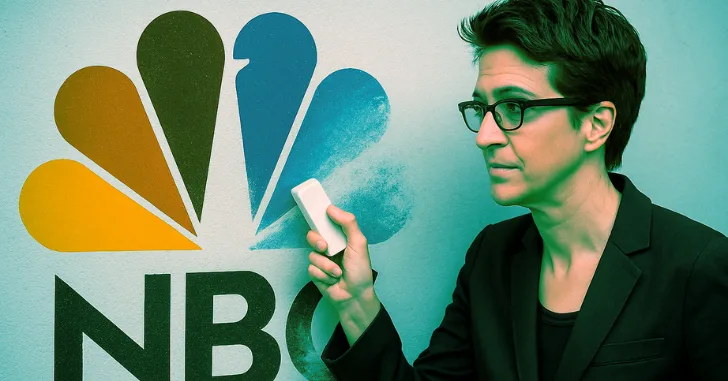
MSNBC, one of the most recognized names in cable news, is about to shed both its name and its iconic peacock logo. The left-leaning network announced it will rebrand as MS NOW (My Source News Opinion World) ahead of its spinoff from Comcast’s NBCUniversal, a move that marks one of the most dramatic identity shifts in the network’s nearly 30-year history.
The decision is part of a broader $7 billion spinoff deal that will carve out NBCUniversal’s portfolio of cable channels—CNBC, USA Network, Oxygen, E!, and others—into a new company called Versant, led by Mark Lazarus. While CNBC will keep its name (with a new logo), MSNBC is stepping away from its NBC roots to clarify its identity as a news-and-opinion network aimed at a progressive audience.
For investors, this rebrand is more than cosmetic. It signals major shifts in the cable news ecosystem, the economics of media spin-offs, and the battle for audience loyalty in an era dominated by streaming and digital-first platforms.
Why MSNBC Is Rebranding
MSNBC has long carried the NBC name and its familiar peacock logo, branding that tethered it to one of the oldest and most respected names in American broadcasting. But with the NBC cable network spinoff on the horizon, executives decided to draw sharper lines between what stays under NBCUniversal and what moves to Versant.
- NBC Keeps Prestige Brands: NBC, Bravo, and the Peacock streaming service remain under NBCUniversal’s umbrella.
- Versant Inherits Cable Assets: MSNBC, CNBC, USA, Oxygen, and E! will move into the new company.
- No More Peacock Logo: To avoid “brand confusion,” MSNBC will no longer use the iconic NBC imagery.
Lazarus explained that while MSNBC initially wasn’t expected to undergo a name change, discussions about its dual role as both news and opinion programming shifted the strategy. NBC executives preferred to retain the NBC name for properties that focus on traditional journalism, leaving the spinoff networks to forge their own identity.
Rebecca Kutler, MSNBC’s new president, emphasized that early reactions to the MS NOW brand were mixed but have grown more positive as staff understood its vision. The network aims to expand its newsgathering operations while doubling down on its role as a platform for progressive commentary.
The Bigger Picture: Why Media Companies Rebrand
MSNBC’s rebrand comes in the context of a wider media industry trend where companies are refreshing—or outright reinventing—their brands to stay relevant.
- Warner Bros. Discovery recently shifted its Max streaming service back to HBO Max, betting on HBO’s premium reputation.
- Dotdash Meredith rebranded as People Inc., leveraging its flagship magazine’s recognition.
- Roku unveiled a new streaming service called Howdy, signaling a quirky, consumer-friendly direction.
For investors, these moves highlight the pressure on legacy media to differentiate themselves in a saturated, fragmenting market. With audiences splintered across streaming, social media, and niche digital platforms, clarity of brand identity matters more than ever.
What Investors Should Watch
1. The Versant Spinoff and Valuation
Comcast’s decision to spin off its cable networks into Versant comes with a $7 billion price tag. For Comcast investors, this represents a strategic pruning: offloading lower-growth assets while keeping higher-value properties like NBC broadcast, Peacock, and Bravo.
The question is whether Versant, as a standalone, can generate enough scale and advertising revenue to compete in a market where cable subscriptions are steadily declining. Versant will inherit both the strengths (brand recognition, distribution) and weaknesses (cord-cutting exposure, aging demographics) of its portfolio.
2. Impact on MSNBC’s Ratings
MSNBC has consistently ranked as the second-most-watched cable news network, behind Fox News and ahead of CNN. But name changes always carry risk: will loyal viewers stick with MS NOW, or will confusion and brand detachment erode viewership?
Advertisers pay close attention to brand recognition and audience loyalty. A successful rebrand could position MS NOW as a fresher, bolder progressive outlet. A failed one could weaken its negotiating leverage in ad sales.
3. The Future of CNBC
Unlike MSNBC, CNBC will retain its name. That’s no accident: the CNBC brand is entrenched among investors, traders, and business audiences. But CNBC will undergo a logo change, signaling an effort to modernize without losing its market credibility. For financial advertisers and sponsors, CNBC remains the premier cable destination, though it faces growing competition from Bloomberg, YouTube-based finance channels, and independent newsletters.
4. Streaming and Digital Expansion
Both MSNBC and CNBC face the same existential challenge: cord-cutting. As households ditch traditional cable packages, these networks must aggressively grow their digital presence. MS NOW’s rebrand may be a signal that the network intends to expand into streaming-first offerings and possibly subscription-based digital models.
For investors, that means evaluating whether MS NOW and CNBC can pivot fast enough to capture the cord-cutter generation, or whether they’ll be left behind as streaming giants like Netflix, YouTube, and TikTok eat into their market share.
Cable News Viewership Trends
Here’s a snapshot of average U.S. prime-time cable news viewership (in millions) over the past five years:
| Year | Fox News | MSNBC | CNN |
|---|---|---|---|
| 2020 | 3.6 | 2.1 | 1.8 |
| 2021 | 2.9 | 1.6 | 1.1 |
| 2022 | 2.5 | 1.4 | 0.7 |
| 2023 | 2.3 | 1.3 | 0.6 |
| 2024 | 2.2 | 1.2 | 0.6 |
The chart illustrates MSNBC’s relative stability in the No. 2 slot but also underscores the broader industry challenge: declining cable news audiences across the board.
Risks and Opportunities for Investors
Risks:
- Viewer Confusion: A name change could alienate older, loyal viewers who strongly associate MSNBC with its NBC heritage.
- Cord-Cutting Pressure: Cable networks continue to lose subscribers, reducing ad reach and bargaining power with distributors.
- Political Polarization: MS NOW’s focus on serving a progressive audience could limit advertiser diversity if brands shy away from partisan environments.
Opportunities:
- Fresh Brand Identity: A successful rebrand could reinvigorate the network and attract a younger, more digital-savvy audience.
- Spin-Off Efficiency: As part of Versant, MS NOW may gain more operational flexibility than under Comcast’s centralized structure.
- Digital Growth: If MS NOW invests heavily in streaming and on-demand platforms, it could capture new revenue streams outside traditional cable.
Investor Takeaways
- For Comcast Investors: The spin-off allows Comcast to slim down, focus on high-growth segments like streaming and broadband, and avoid dragging down its valuation with legacy cable assets.
- For Prospective Versant Investors: This is a classic spin-off play—legacy assets grouped together with a mandate to prove their standalone value. Watch advertising trends, carriage fee negotiations, and digital pivots closely.
- For Media Sector Investors: The MS NOW rebrand signals a broader industry reality: legacy cable networks must reinvent themselves or risk irrelevance.
Reinvention or Risky Gamble?
MSNBC’s transformation into MS NOW is more than a new logo and name. It’s a test of whether a legacy cable news network can reinvent itself in an era where audiences have more choices than ever—and less patience for brand confusion.
For investors, the question isn’t just whether MS NOW can hold onto its No. 2 spot behind Fox News, but whether it can evolve into a digital-first player with revenue streams beyond cable. The Versant spinoff will serve as a live experiment in whether traditional media brands can shed their past and find growth in a crowded, fast-moving landscape.
Bottom line: MS NOW could either be a smart play that revitalizes a fading cable brand—or a risky gamble that accelerates its decline. Investors would do well to keep a close eye on subscriber trends, ad revenue, and Versant’s ability to carve out a future in a streaming-dominated world.
About Author