

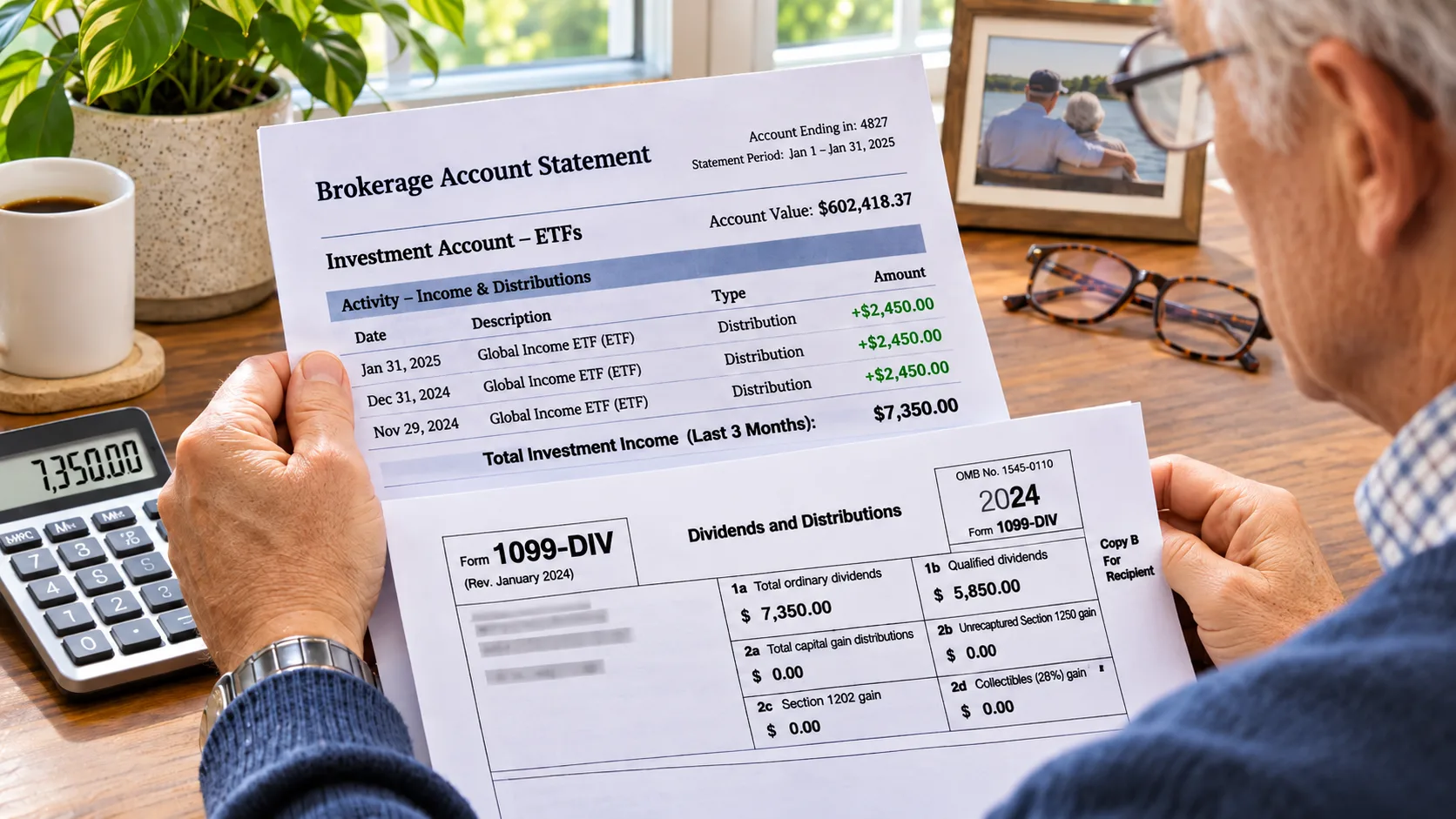
Covered call ETFs promise attractive monthly payouts, sometimes approaching double-digit annual distribution rates. But retirees who overlook how that income is taxed could end up keeping far less than they expected.
For millions of Americans approaching or already in retirement, the idea of receiving a dependable monthly payment from their investments is hard to resist. A growing category of exchange-traded funds offers exactly that, with some advertising annualized distribution rates considerably higher than traditional stock dividends or Treasury securities.
But there’s a catch. The income investors receive can trigger unexpected taxes, reduce their original investment’s cost basis, and limit the long-term growth of their retirement savings.
For retirees counting on that money to cover living expenses, the difference between the advertised payout and what they actually keep can be substantial.
Why Monthly Income ETFs Are Attracting Retirees
The funds at the center of this trend are known as covered call ETFs. They combine stock investments with options strategies designed to generate additional cash flow.
Unlike a traditional dividend ETF, which relies primarily on companies distributing a portion of their profits, covered call strategies generate money by selling options tied to stocks or market indexes.
In exchange for receiving option premiums, the fund generally gives up some potential gains when the market rises sharply.
The approach can be appealing to investors who prioritize immediate income over maximizing portfolio growth. It has also helped make funds such as the JPMorgan Equity Premium Income ETF (JEPI), JPMorgan Nasdaq Equity Premium Income ETF (JEPQ), and NEOS S&P 500 High Income ETF (SPYI) popular alternatives for income-focused portfolios.
These products are particularly interesting to retirees who want to supplement Social Security, pensions, or other retirement income without regularly selling shares.
There is a significant trade-off, however. Monthly distributions are not guaranteed, and an attractive payout does not necessarily translate into an equally attractive investment return.
The Tax Surprise Many Investors Discover Too Late
One of the biggest misconceptions surrounding ETFs is that their traditional tax efficiency automatically extends to every type of distribution they make.
Covered call ETFs can distribute several different categories of income, each carrying different tax consequences.
| Distribution type | Potential tax treatment |
|---|---|
| Ordinary, nonqualified dividends | Generally taxed at ordinary income rates |
| Qualified dividends | Generally eligible for lower long-term capital gains rates |
| Capital gain distributions | Treatment depends on the applicable tax classification |
| Return of capital | Generally reduces cost basis and defers taxes until a later sale |
This distinction matters because two funds distributing the same amount of cash can leave investors with very different after-tax results.
Consider a retiree receiving $10,000 in annual distributions from an ETF held in a taxable brokerage account.
If all $10,000 is classified as nonqualified ordinary dividends and the investor faces a 24% federal marginal tax rate, the federal tax bill could reach $2,400, leaving $7,600 before any applicable state taxes.
If the same $10,000 qualifies for a 15% federal long-term capital gains rate, the federal tax cost could instead be $1,500, leaving $8,500.
Illustrative example. Assumes the stated rates apply to the entire distribution, with no additional tax adjustments.
The difference is $900 per year on the same $10,000 cash payment.
Over a decade, that gap could exceed $9,000 before considering reinvestment, changes in tax rates, or other investment returns.
The actual outcome depends on the fund’s tax reporting and the investor’s circumstances. Nevertheless, it illustrates why evaluating these investments solely by their advertised distribution rates can be misleading.
The Return-of-Capital Trap
Another complication involves something called return of capital, often abbreviated ROC.
When a fund distributes money classified as return of capital for tax purposes, the payment generally does not create an immediate federal income tax liability as long as the investor still has sufficient cost basis.
That sounds attractive, especially for retirees seeking tax-efficient income.
But the IRS requires those payments to reduce the investor’s cost basis. As a result, the eventual taxable gain may be larger when the investment is sold.
Consider this simplified example:
How $20,000 in Distributions Can Change Your Tax Bill
If the shares are eventually sold for $100,000, the investor has a $20,000 capital gain, even though the sale price equals the original purchase price.
Assumes a long-term gain, sufficient taxable income for the 15% rate, and no other tax adjustments. Example is for illustration only.
There is an important distinction here. Return of capital is a tax classification and does not automatically mean the fund is economically giving investors back their own money or losing value. Its portfolio may still be profitable.
However, the tax deferral is real, and so is the potential future tax obligation. Once an investor’s basis reaches zero, additional nondividend distributions generally become taxable capital gains.
This is especially relevant for retirees who may need to liquidate investments later to cover healthcare expenses, assisted living, or unexpected financial needs.
Three Popular ETFs Can Produce Very Different Outcomes
Covered call funds may pursue similar objectives while using substantially different strategies.
JEPI seeks income from a diversified equity portfolio and options-related instruments. JEPQ uses a similar income-oriented approach with greater exposure to Nasdaq-related growth stocks.
SPYI takes another approach, using an S&P 500-oriented portfolio and index options designed to generate monthly income with potential tax efficiencies.
Fund expenses also vary.
| ETF | Annual expense ratio |
|---|---|
| JEPI | 0.35% |
| JEPQ | 0.35% |
| SPYI | 0.68% |
These expenses are generally deducted within the funds, reducing returns available to investors.
The tax differences can be even more significant. Some strategies distribute relatively large amounts of ordinary taxable income, while others use approaches that can result in a greater share of distributions being characterized as return of capital.
But investors need to be cautious when evaluating those claims.
A fund’s preliminary monthly distribution notices may estimate how much is classified as return of capital. Those estimates can change before the final tax classification is issued on Form 1099-DIV.
The final tax treatment, rather than an initial distribution announcement, determines what investors must report.
Why a High Distribution Rate Can Be Misleading
Investors evaluating these funds often focus on one number: the annualized distribution rate.
For someone with $250,000 to invest, a fund distributing cash at a 10% annualized rate suggests approximately $25,000 in yearly payments, assuming the rate and investment value remain unchanged.
That can look considerably more attractive than the income available from many conventional dividend investments.
But distribution rates and investment returns measure different things.
A fund can pay a large distribution while its share price declines. The investor may receive substantial cash without generating a comparable economic profit.
For example, imagine a $100,000 investment that distributes $10,000 over one year while the value of the remaining shares falls to $94,000.
The investor now has $104,000 in combined cash and shares, representing a 4% total return before taxes, even though the distribution equaled 10% of the original investment.
The distinction becomes especially important when investors spend the distributions rather than reinvesting them.
If a fund’s net asset value steadily deteriorates, future payments may represent a progressively smaller dollar amount, even when the advertised distribution percentage remains attractive.
Investors also sacrifice some upside through the options strategy. During a powerful stock market rally, the fund may significantly underperform the underlying index.
That creates a difficult trade-off for retirees who need their portfolios to continue growing over a retirement that could last 20 or 30 years.
Where Investors Hold These ETFs Can Make a Major Difference
One way to manage the immediate tax consequences is to consider which type of investment account holds the fund.
Covered call ETFs can be particularly cumbersome in taxable brokerage accounts because ordinary taxable distributions may be generated throughout the year, regardless of whether the investor needs the cash.
In a traditional IRA, the treatment is different. Income generated within the account generally does not trigger an annual tax bill for the account holder. Taxes typically become due when money is withdrawn, with traditional IRA distributions generally taxed as ordinary income.
This makes account placement an important consideration.
However, retirees should recognize that withdrawals from traditional IRAs can affect their overall taxable income. Depending on their circumstances, those withdrawals could also influence taxation of Social Security benefits or Medicare premium calculations.
A Roth IRA can offer different advantages when withdrawals satisfy the applicable qualified-distribution requirements.
There is no universal answer for every investor. The appropriate account depends on tax rates, retirement income needs, withdrawal plans, and the broader investment portfolio.
A Little-Known Number Can Reveal the Real Tax Cost
Investors comparing income ETFs should look beyond the expense ratio and advertised payout.
Another useful measure is the tax-cost ratio, which estimates how much a fund’s annualized return has been reduced by taxes on distributions under standardized assumptions.
Morningstar provides this measure for eligible funds.
A fund with a higher tax-cost ratio has historically surrendered more of its return to distribution-related taxes under the calculation’s assumptions.
This can be particularly useful when comparing funds that pursue similar income objectives but use different options strategies.
There are limitations. Historical tax classifications can change, and a standardized tax-cost ratio may differ substantially from what an individual retiree actually owes.
Still, the measure offers a way to identify potential tax inefficiencies before making an investment.
The Overlooked Alternative: Create Your Own Monthly Income
Covered call ETFs solve a genuine problem for retirees: the desire for predictable cash flow.
But automatic monthly distributions aren’t necessarily the most efficient way to generate that cash flow.
An investor holding a low-cost S&P 500 or total-market ETF could collect ordinary portfolio dividends and periodically sell a small number of shares to fund retirement expenses.
That approach gives the investor greater control over the timing of taxable sales and, potentially, access to preferential long-term capital gains treatment.
It also preserves more of the portfolio’s upside potential during strong markets because the investor isn’t selling call options that limit gains.
The trade-off is that withdrawals may require selling shares when markets are weak, and equity index funds generally provide less immediate cash income than high-distribution options strategies.
Another possibility is combining Treasury securities, investment-grade bonds, dividend-paying stocks, and cash reserves to create a more diversified retirement income plan.
Each approach carries its own risks, including inflation, interest-rate changes, market volatility, and the possibility of withdrawing too much during a downturn.
The goal is to balance cash flow, tax efficiency, capital preservation, and long-term growth.
Four Questions Retirees Should Ask Before Buying
Before committing retirement savings to a covered call ETF, investors should examine four areas:
1. How much of the payout will I actually keep? Review the fund’s historical distribution classifications and estimate federal and state taxes based on personal circumstances.
2. Is the fund maintaining its value? Compare its total return, distribution history, and net asset value over multiple years. A high payout is less attractive if capital value is steadily eroding.
3. Am I sacrificing too much growth? Compare the fund’s long-term performance with a comparable stock index, including reinvested distributions and expenses.
4. Is this the right investment account? Consider whether holding the fund in a taxable brokerage account, traditional IRA, or Roth IRA better fits the overall retirement strategy.
Investors should also review the fund’s annual Form 1099-DIV reporting, recent distribution notices, and current prospectus. Distribution composition, fees, and investment strategies can change.
The Real Retirement Risk Is Keeping Less Than Expected
Monthly income ETFs can play a legitimate role in retirement portfolios, particularly for investors who understand the trade-offs and prioritize current cash flow.
Their popularity reflects a broader challenge facing older Americans: generating enough income from retirement savings without taking excessive investment risk.
But the payout that appears in a brokerage account each month tells only part of the story.
Taxes, fund expenses, declining share values, and missed market gains can all reduce the economic value of those distributions.
For retirees, the most important number is ultimately how much money remains available after taxes and investment costs, while preserving enough capital to support their future needs.
A fund paying 10% in cash is appealing. Whether it delivers a satisfactory after-tax total return is the question that determines its value in retirement.
About Author