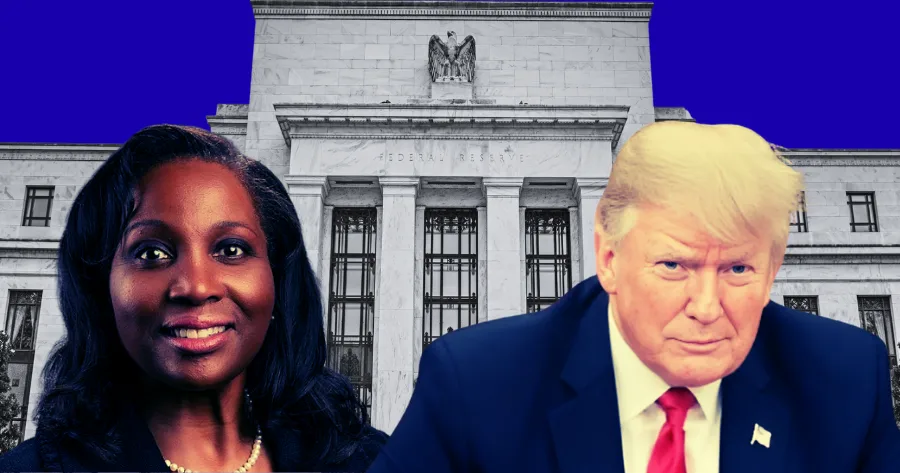
On August 25, 2025, President Donald Trump announced that he was firing Federal Reserve Governor Lisa Cook, citing allegations that she misrepresented her residency status on mortgage applications to obtain favorable loan terms. The announcement marks the first time in modern history that a U.S. president has attempted to directly remove a sitting Fed governor, and it has triggered a storm of political, legal, and market consequences.
The move raises three critical questions:
- Does the president actually have the authority to fire Cook?
- What will Fed Chair Jerome Powell do?
- Does this mean the White House now effectively controls the Federal Reserve?
The Allegations Against Lisa Cook
President Trump accused Cook of “mortgage fraud,” alleging that she improperly claimed two different properties as her primary residence to obtain favorable loan terms. “No one is above the law—not even a Federal Reserve governor,” Trump said in a Truth Social post announcing the move (AP News).
Cook strongly denies the allegations and has made clear she will not step down voluntarily. Through her attorney, Abbe Lowell, she stated:
“President Trump has no legal authority to remove Governor Cook. This is an illegal and unconstitutional abuse of power.”
The dispute is now headed for a legal showdown that could determine the future independence of the Federal Reserve.
Does the President Have the Authority to Fire Cook?
The Federal Reserve Act allows governors to be removed only “for cause.” Historically, this has meant evidence of gross misconduct, criminal conviction, or incapacity—not a unilateral political decision. In fact, no sitting president has ever successfully fired a Fed governor.
Legal experts point to a 1935 Supreme Court case, Humphrey’s Executor v. United States, which ruled that independent regulators could not be removed by the president without just cause. More recently, the Court has narrowed some of these protections in cases involving the CFPB and the FHFA, but the Fed’s unique independence has never been directly tested.
The big issue: Does “for cause” mean the president can act as judge and jury, or does it require due process in the courts? Most constitutional scholars believe Trump cannot fire Cook without judicial confirmation of misconduct, meaning this will almost certainly end up in federal court (Reuters).
What Will Fed Chair Powell Do?
Jerome Powell is now caught in the middle. If he accepts Trump’s claim of authority and allows Cook to be removed, the Fed’s independence will take a historic hit. If he refuses, Powell risks escalating a confrontation with the White House.
So far, Powell has remained cautious, telling reporters the Fed will “continue its work without political interference,” but not directly commenting on Cook’s status (AP News).
Behind the scenes, Fed insiders suggest Powell will back Cook unless a court rules otherwise. The Fed’s credibility in financial markets rests on the perception that it operates above partisan politics. If Powell caves, investors may start pricing in political risk to Fed policy—a dangerous precedent.
Does the President Now Control the Fed?
In practical terms, Trump’s move is part of a broader strategy to pressure the Fed into lowering interest rates. He has repeatedly blasted Powell and other Fed officials as “incompetent” for not cutting rates quickly enough. Removing Cook, who has generally supported a cautious stance on inflation, could tilt the balance of the board toward Trump-aligned nominees.
But here’s the catch: Even if Trump succeeds, it won’t immediately give him control. Fed governors serve staggered 14-year terms to ensure continuity. However, by opening a vacancy, Trump can nominate someone more aligned with his vision of rapid rate cuts—if the Senate confirms them.
That said, the fight itself could undermine the Fed’s institutional authority. Markets thrive on certainty. If investors believe future Fed decisions are politically motivated, they may demand higher risk premiums on U.S. debt—driving up borrowing costs across the economy (FT).
Market Reaction: A Classic “Flight to Safety”
The announcement immediately rattled financial markets:
- Treasury yields split: Short-term yields dropped as traders bet on politically forced rate cuts, while long-term yields spiked on fears of inflation and fiscal instability.
- Stocks slipped: Futures pointed lower as Wall Street weighed the risk of policy uncertainty.
- Dollar weakened: A less independent Fed undermines confidence in U.S. monetary policy, pressuring the greenback.
Here’s a look at how the Treasury market reacted:
This inverted reaction—short rates falling, long rates rising—is a clear sign investors expect turbulence: easier policy in the short run, but more risk in the long run.
Why This Matters for Investors
1. Expect More Volatility
Markets are entering uncharted waters. The independence of the Federal Reserve has been a bedrock assumption for decades. If that changes, volatility in equities, bonds, and currencies is inevitable.
2. Watch the Courts
The legal process will be slow, but investors need to track court filings closely. A ruling that backs Trump could permanently alter the balance of power between the White House and the Fed.
3. Inflation vs. Growth Risks
If Trump succeeds in reshaping the Fed, expect a faster pivot to rate cuts. That may boost growth-sensitive assets like equities and real estate in the short term but could reignite inflation and undermine Treasuries.
4. Global Credibility at Stake
The U.S. dollar’s status as the world’s reserve currency depends heavily on faith in the Fed. Undermining that credibility could accelerate de-dollarization trends already underway.
What Investors Should Do Now
- Hedge bond exposure: Long-term Treasuries are most at risk from a perceived loss of Fed independence. Shorter-duration bonds or T-bills may offer safer exposure.
- Stay defensive in equities: Focus on sectors resilient to interest rate swings—utilities, healthcare, and consumer staples.
- Watch gold and crypto: Both have rallied in past periods of Fed credibility crises. A political storm around the Fed could reignite safe-haven demand.
- Stay nimble: This is a fast-moving situation. Positioning too aggressively on one outcome could backfire if courts push back against Trump.
A Rare Moment in Monetary History
This episode is bigger than one governor. It’s a stress test of America’s institutional resilience. For decades, the Fed’s independence was taken for granted. Now that assumption is under direct attack. Investors are witnessing a live experiment in how much politics can reshape central banking.
Making Sense of the Noise
For everyday investors, this drama can feel abstract. But the practical stakes are clear: the outcome will affect interest rates, mortgage costs, inflation, and portfolio returns. The key is not to panic, but to stay informed and recognize that markets are reacting to the same uncertainty you are. That means volatility creates risks—but also opportunities.
The Bottom Line
President Trump’s attempt to fire Fed Governor Lisa Cook is unprecedented and legally contested. Whether he has the authority remains unclear and will almost certainly be tested in court. Jerome Powell’s next steps will be critical, not only for Cook but for the Fed’s independence as an institution. And while Trump does not yet control the Fed, even the perception that he might is already rippling through global markets.
For investors, this is a moment to stay disciplined, defensive, and alert. The fight over Cook isn’t just about one governor—it’s about the future of American monetary policy itself.
About Author