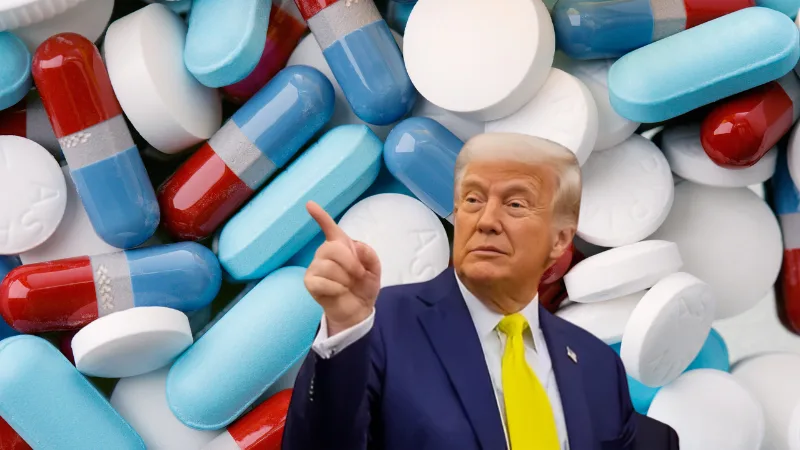
President Donald Trump has launched a new offensive against high prescription drug prices in the U.S., formally asking 17 of the world’s largest pharmaceutical companies to cut costs within 60 days or face aggressive action from his administration. This move signals a renewed push to tackle one of the most politically sensitive economic issues ahead of the 2025 election—and it could have real financial consequences for drugmakers, insurers, and investors alike.
In a series of public letters posted to Truth Social, Trump urged companies to adopt a pricing model that ties U.S. drug prices to the lowest available rates in other developed nations, a policy known as the Most-Favored-Nation (MFN) approach. This follows his May executive order reviving the controversial plan to benchmark domestic prices against international ones.
📉 Following the announcement, shares of several major drugmakers dropped sharply, with Sanofi down over 8%, and Bristol Myers Squibb and Novo Nordisk each falling nearly 5%.
A Political Showdown With Big Pharma
Trump’s move isn’t just regulatory—it’s political theater with real teeth. In his letters, he accuses the pharmaceutical industry of offering half-measures that deflect blame and seek handouts. “We will deploy every tool in our arsenal to protect American families from continued abusive drug pricing practices,” Trump wrote, giving companies a deadline of September 29 to commit to specific price-cutting steps.
This escalation may mark a turning point in how the U.S. government exerts pricing pressure on Big Pharma, especially in light of Trump’s revived “most-favored-nation” pricing strategy, which was previously shelved due to industry pushback and legal uncertainty.
The 17 companies receiving letters include:
- Pfizer
- Eli Lilly
- GSK
- Merck
- Regeneron
- Novo Nordisk
- AbbVie
- Amgen
- AstraZeneca
- Sanofi
- Johnson & Johnson
- Bristol Myers Squibb
- Genentech
- Gilead
- Novartis
- Boehringer Ingelheim
- EMD Serono
Why This Matters to Americans and the Market
U.S. drug prices remain two to three times higher than in other developed countries, and in some cases, up to 10 times more, according to RAND Corporation. This disparity has created a political powder keg, with patients facing ever-rising costs for life-saving medications like insulin, cancer therapies, and autoimmune treatments.
Trump’s strategy is aimed at ending what he calls the “free ride” other nations take on U.S. pharmaceutical innovation—where European countries negotiate lower prices while American taxpayers and consumers foot the global bill.
For investors, this is not just about policy—it’s about profit margins, international pricing leverage, and new direct-to-consumer models that could disrupt legacy distribution chains and impact companies’ bottom lines.
What Trump Is Demanding
President Trump laid out four specific actions he wants drugmakers to take:
1. Match Foreign Prices for Medicaid
Drugmakers must provide their full portfolio of existing medicines to Medicaid patients at the lowest price they offer in any other developed country—the so-called “most-favored-nation price.”
2. Guarantee MFN Pricing for All New Drugs
Trump is calling on pharmaceutical companies to contractually guarantee that Medicare, Medicaid, and commercial insurers will receive most-favored-nation prices on all new drugs at launch and in perpetuity.
3. Negotiate Tougher With Foreign Governments
Trump urged drugmakers to aggressively renegotiate with “foreign freeloading nations” and insisted that any additional revenue they secure abroad should be used to offset U.S. prices through repatriation.
4. Cut Out the Middlemen
Companies are encouraged to explore direct-to-consumer or business models that bypass pharmacy benefit managers (PBMs) and insurers—ensuring that all Americans get access to internationally competitive pricing.
Industry Pushback Begins
The pharmaceutical industry, unsurprisingly, is pushing back. PhRMA, the powerful lobbying group representing drugmakers, said Trump’s proposal to import international price controls would “undermine American leadership” in drug innovation and ultimately harm patients and workers.
“To reduce price differences with other countries, U.S. officials should rein in healthcare middlemen driving up costs and get foreign countries to pay their fair share,” PhRMA stated, referencing PBMs and insurers.
Some companies have signaled openness to negotiation. Pfizer said it is having “productive discussions” with the Trump administration and Congress. Novartis confirmed receipt of the letter and is currently reviewing it. Novo Nordisk and AstraZeneca also indicated they are exploring direct-to-patient pricing models.
Market Fallout: Stocks Slide, Uncertainty Rises
Wall Street reacted swiftly to the announcement, with investors fearing tighter pricing power and potential long-term regulatory changes. The broad pharmaceutical sector slipped, with notable declines in:
- Sanofi (-8.2%)
- Novo Nordisk (-4.9%)
- Bristol Myers Squibb (-4.8%)
- GSK (-3.2%)
- Merck (-3.1%)
The looming threat of tariffs on pharmaceutical imports—reportedly under review by the Trump administration—has added another layer of uncertainty for multinational drug companies.
What This Means for Investors
For shareholders, this marks a pivotal moment. Trump’s bold push may reshape how drug pricing works in the U.S., especially if pharmaceutical companies preemptively adopt new pricing strategies to avoid regulatory mandates or public backlash.
Key takeaways for investors:
- Expect near-term stock volatility in major pharmaceutical players, especially those heavily exposed to U.S. sales and pricing models.
- Direct-to-consumer models may create new revenue streams or partnerships with retail players like Amazon or Walmart.
- International pricing negotiations will become more strategic, as companies try to preserve margins globally while complying with U.S. mandates.
- Watch for copycat proposals from lawmakers or regulators seeking to replicate Trump’s aggressive approach in state policies or legislative initiatives.
Is This the Beginning of Drug Price Reform?
Trump’s latest move is more than a headline—it’s a policy marker. If successful, it could permanently alter how drugs are priced and sold in America, creating both risks and opportunities for investors and companies.
With the September 29 deadline looming, pharmaceutical executives, policy experts, and Wall Street will be watching closely to see which companies bend—and which fight back.
Sources:
About Author