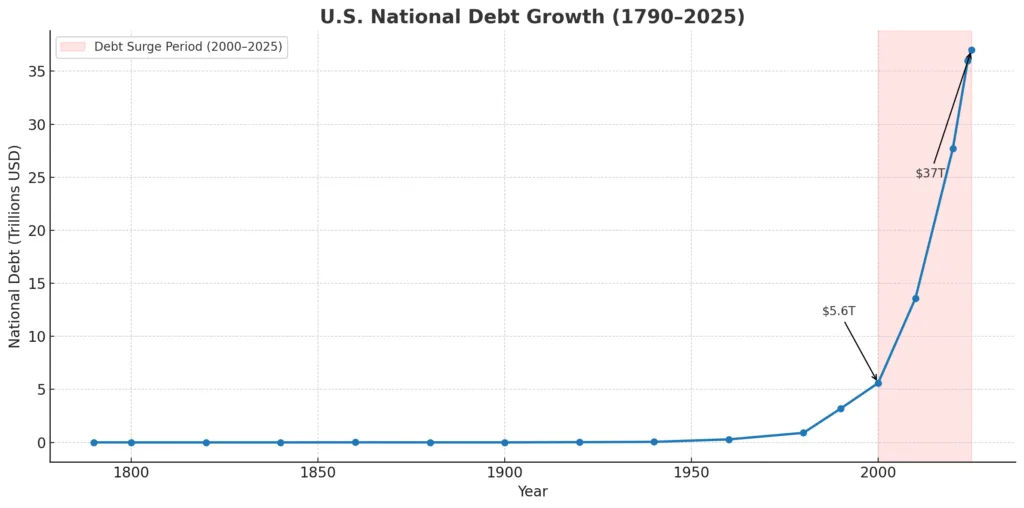
The U.S. government has crossed another staggering fiscal milestone: total national debt now exceeds $37 trillion, setting a new record and underscoring the country’s accelerating borrowing pace. For investors, this isn’t just a headline — it’s a macroeconomic signal with direct implications for interest rates, credit ratings, inflation, and long-term portfolio strategy.
A Rapid Climb to a New Record
Fresh Treasury Department data shows the gross national debt hit $37,004,817,625,842.56 earlier this week. This jump comes less than eight months after the U.S. breached the $36 trillion mark in late November 2024, and barely a year after topping $35 trillion in July 2024.
Debt accumulation at this speed has few precedents outside wartime or major crisis spending. The sheer velocity — adding roughly $1 trillion every eight months — suggests structural imbalances, not one-off emergency measures.
Debt-to-GDP Nearing Historic Highs
While the gross figure grabs attention, economists often look at publicly held debt — the portion owed to outside investors rather than to internal government accounts like Social Security trust funds. That figure is projected to reach 99% of GDP this year, putting the U.S. within striking distance of its all-time high debt burden relative to economic output.
For context, debt-to-GDP ratios above 90% are often cited in economic research as a level where growth can be restrained and fiscal flexibility reduced. That means less room for stimulus in a downturn and greater vulnerability to rising interest rates.
Warning Signs From Fiscal Experts
Maya MacGuineas, president of the Committee for a Responsible Federal Budget, did not mince words:
“Reaching this milestone is a moment no one in Washington can be proud of – our fiscal situation is woefully unbalanced, yet Congress keeps on making the situation worse… We’re headed toward record levels and on course to spend $1 trillion just on interest costs.”
Michael A. Peterson, CEO of the Peter G. Peterson Foundation, noted the global scale of the problem:
“Our national debt is now greater than the economies of the entire Eurozone and China, combined… Despite today’s unfortunate milestone, it’s not too late to act.”
Both underscore the same message: the U.S. is on an unsustainable fiscal path, and the cost of inaction will rise exponentially.
Why This Matters for Investors
- Interest Rate Pressure – Financing trillions in new debt could push Treasury yields higher, raising borrowing costs across the economy. This can impact everything from mortgage rates to corporate debt refinancing.
- Inflation Risk – Large, persistent deficits can be inflationary if demand outpaces supply, especially if financed by central bank purchases of government bonds.
- Credit Rating Impact – Ratings agencies, like Moody’s (which has already downgraded U.S. credit over debt concerns), could take further action, leading to higher risk premiums for U.S. debt.
- Crowding Out Private Investment – Heavy government borrowing can compete with the private sector for capital, potentially slowing innovation and business expansion.
- Market Volatility – Fiscal instability is a macro risk that can shake investor confidence, leading to sell-offs in equities, currency fluctuations, and safe-haven flows into gold or other assets.
Forward-Looking Risks
If current trends continue, interest payments could become the fastest-growing category of federal spending within the next decade, overtaking defense and Medicare. This could spark politically painful choices: raise taxes, cut spending, or monetize debt (which risks further inflation).
Additionally, higher yields on Treasurys could shift portfolio flows. For income-focused investors, rising yields may offer attractive alternatives to equities — but that same shift could put pressure on stock valuations.
Investor Takeaways
- Diversify by Interest Rate Exposure – Consider balancing growth stocks with sectors that benefit from higher rates, such as financials.
- Look at Inflation Hedges – Commodities, real estate, and inflation-protected securities (TIPS) may gain appeal.
- Watch Fiscal Negotiations – Budget showdowns in Congress can trigger short-term volatility and long-term policy shifts.
- Monitor Treasury Auctions – Weak demand or rising yields in these auctions can signal investor unease about U.S. fiscal health.
Bottom Line
The $37 trillion debt milestone isn’t just a symbolic number — it’s a flashing warning light for the U.S. economy and the markets that depend on it. For investors, understanding how this fiscal trajectory intersects with rates, inflation, and credit risk is key to protecting portfolios in the decade ahead.
About Author