Phoebe Gates’ fast-growing shopping startup Phia is facing serious questions after a new report alleged its founders knew for months about a controversial affiliate-marketing practice that allowed the company to claim credit for sales it may not have generated.
And the stakes could go far beyond refunding commissions.
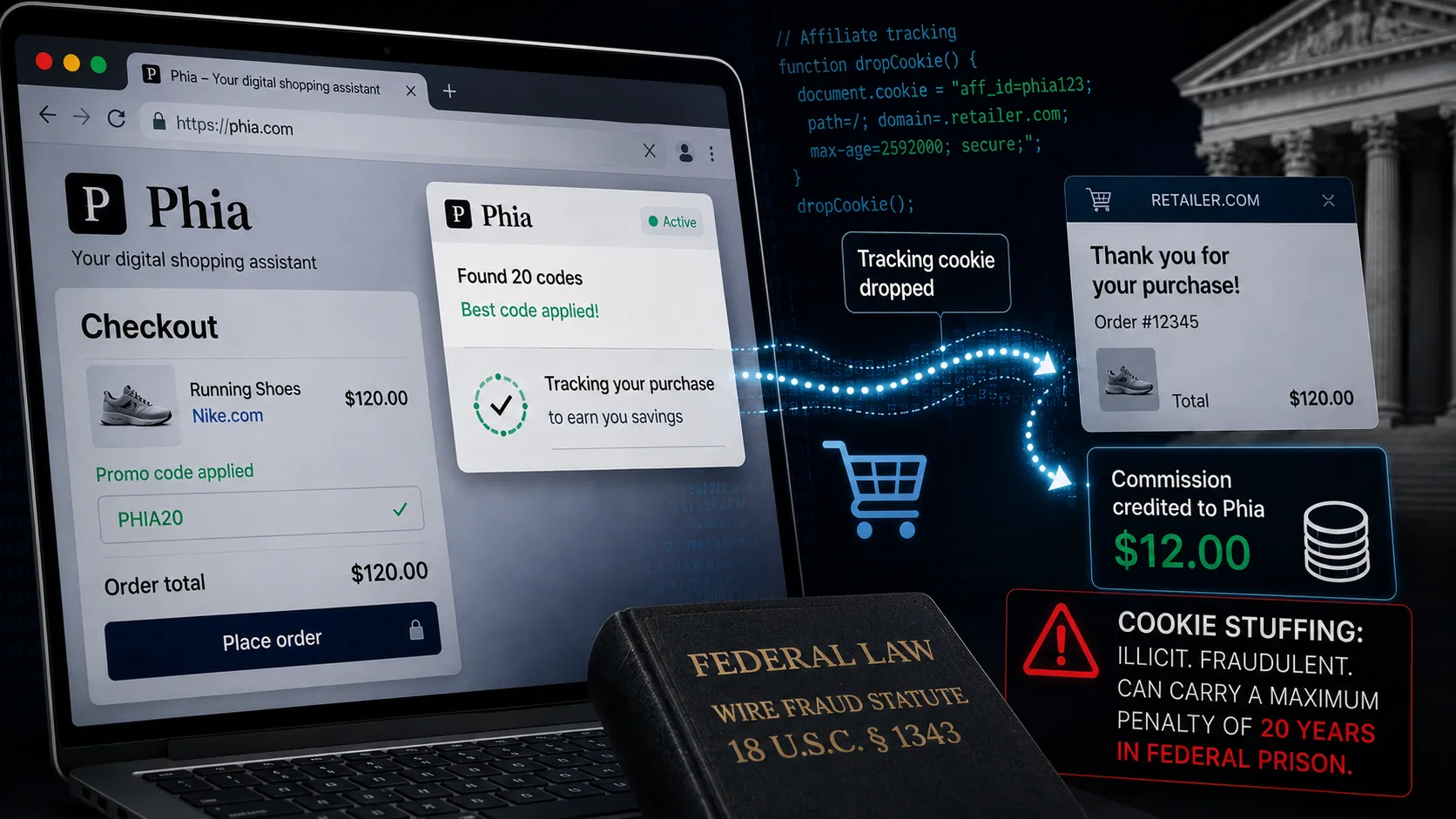
Cookie stuffing has previously been prosecuted as federal wire fraud. In a past federal case involving eBay’s affiliate program, the Justice Department said a wire-fraud conviction carried a statutory maximum of 20 years in prison, although there is currently no indication Gates or her Phia co-founder Sophia Kianni has been charged with a crime.
The controversy centers on new reporting that Gates and Kianni were allegedly aware for months that Phia was dropping affiliate tracking cookies even when shoppers had not taken the actions normally required for Phia to earn a commission.
That allegation directly challenges Phia’s initial explanation that it had only recently discovered a technical problem.
What Phia Is Accused of Doing
Phia is a digital shopping assistant co-founded by Gates, the 23-year-old daughter of Microsoft co-founder Bill Gates, and Kianni, a fellow Stanford alum.
The browser-based shopping tool helps consumers compare products, find deals and discover discounts. Like many online businesses, Phia can make money through affiliate commissions.
Normally, the model is straightforward.
A shopper interacts with an affiliate’s link or promotion, makes a purchase, and a tracking cookie tells the retailer which affiliate helped generate the sale. The affiliate then receives a commission.
Cookie stuffing changes that equation.
Instead of receiving credit only after a legitimate referral, software can place affiliate cookies on a shopper’s browser without the shopper actually clicking the corresponding affiliate link. If that shopper later buys something, the affiliate can potentially receive credit for a transaction it didn’t generate.
That distinction is now at the heart of the Phia controversy.
The Founders Allegedly Knew for Months
Phia initially portrayed the problem as something it had only recently discovered.
But subsequent reporting based on internal communications alleges Gates and Kianni knew about the behavior as far back as December 2025.
According to reports, one internal feature was called “enable coupon auto drop.” Rather than an unpredictable software glitch, the feature could reportedly be turned on or off.
Internal Slack communications cited in the reporting also appear to show Gates asking developers to make sure cookies were being dropped broadly enough to monetize transactions.
In a December message concerning the company’s affiliate activity, Gates reportedly expressed concern about whether automatic cookie drops were active across sites offering coupons.
The distinction matters because Phia’s ability to collect commissions depended on retailers attributing sales to its software.
If cookies were being placed without a legitimate customer interaction, Phia could potentially receive commissions on transactions it did little or nothing to generate.
The Revenue Numbers Raise Even Bigger Questions
Perhaps the most striking part of the report is what allegedly happened to Phia’s revenue after the disputed features were disabled.
Average daily revenue reportedly fell from roughly $80,000 to between $10,000 and $28,000 after Phia removed the features. Phia has disputed the implication of those figures, saying the decline was also caused by the company shutting down other monetization efforts during that period.
But another figure could attract even more scrutiny.
The disputed attribution practices reportedly represented approximately 51% of the merchandise value Phia claimed credit for in June.
The allegedly affected transactions involved major retailers, with reporting identifying companies including Nike, Gap and Nordstrom.
For a startup attempting to prove the strength of its business model, the question is obvious: How much of Phia’s apparent commercial traction came from customers it actually influenced?
Why “Cookie Stuffing” Can Become a Federal Crime
Cookie stuffing isn’t merely an obscure violation of affiliate-marketing etiquette.
Federal prosecutors have previously pursued it as wire fraud.
In a notable case involving eBay, affiliate marketer Brian Dunning pleaded guilty to wire fraud after admitting that his company received commissions for transactions for which it was not entitled to compensation. Prosecutors said his company had received approximately $5.2 million through eBay’s affiliate program during the relevant period.
The Justice Department said the offense carried a maximum statutory penalty of 20 years in prison, along with potential fines and restitution. The maximum penalty is not the same as the sentence a defendant would actually receive, and it does not mean Phia’s founders currently face such a sentence.
Attorney Ariel Givner has publicly warned that cookie-stuffing conduct can potentially be treated as federal wire fraud.
That legal history makes the allegations surrounding Phia considerably more serious than an ordinary dispute between a startup and its affiliate partners.
At this point, however, the reports concern allegations about Phia’s practices. There has been no reported criminal charge against Gates or Kianni tied to the matter.
Phia Says It Is Reversing Transactions
Phia says it has already taken action.
A company spokesperson said features responsible for misattributions were removed on July 7 and that Phia is reviewing transactions and reversing those improperly attributed to the company.
Phia has also said it plans to hire a head of compliance to prevent similar problems in the future.
The company maintains that it remains focused on connecting shoppers with products and offers from thousands of brands.
But the new allegations create a tougher problem for Phia because they challenge its original explanation of how the disputed activity occurred.
If internal communications show executives knew about the cookie-dropping features months earlier, portraying the situation as a newly discovered technical anomaly becomes much harder to reconcile.
Affiliate Partners Are Already Responding
The fallout isn’t limited to public criticism.
Impact.com, an affiliate network used by Phia, reportedly suspended the company and began reallocating commissions that otherwise would have gone to Phia.
Phia could also face additional reversals if disputed transactions stretch back to December rather than covering only the shorter period initially believed.
That could turn the episode into a potentially expensive problem even without any government enforcement action.
The larger question is how retailers and affiliate networks respond now that additional details about the company’s internal discussions have emerged.
A High-Profile Startup Suddenly Under a Microscope
The controversy is particularly striking because of how quickly Phia has attracted money, attention and influential supporters.
The startup has raised tens of millions of dollars while attracting celebrity and high-profile investors. Recent reporting puts Phia’s total funding at more than $40 million.
Gates has also spoken publicly about wanting to build something on her own merits rather than relying on one of the most famous surnames in technology.
Now the company’s growth story faces a very different kind of test.
The key issue isn’t simply whether Phia’s software improperly attributed transactions. The more consequential question is who knew what was happening, when they knew it and whether the behavior was intentionally used to increase revenue.
Those answers could determine whether this remains an embarrassing affiliate-marketing controversy or develops into something far more serious.
About Author