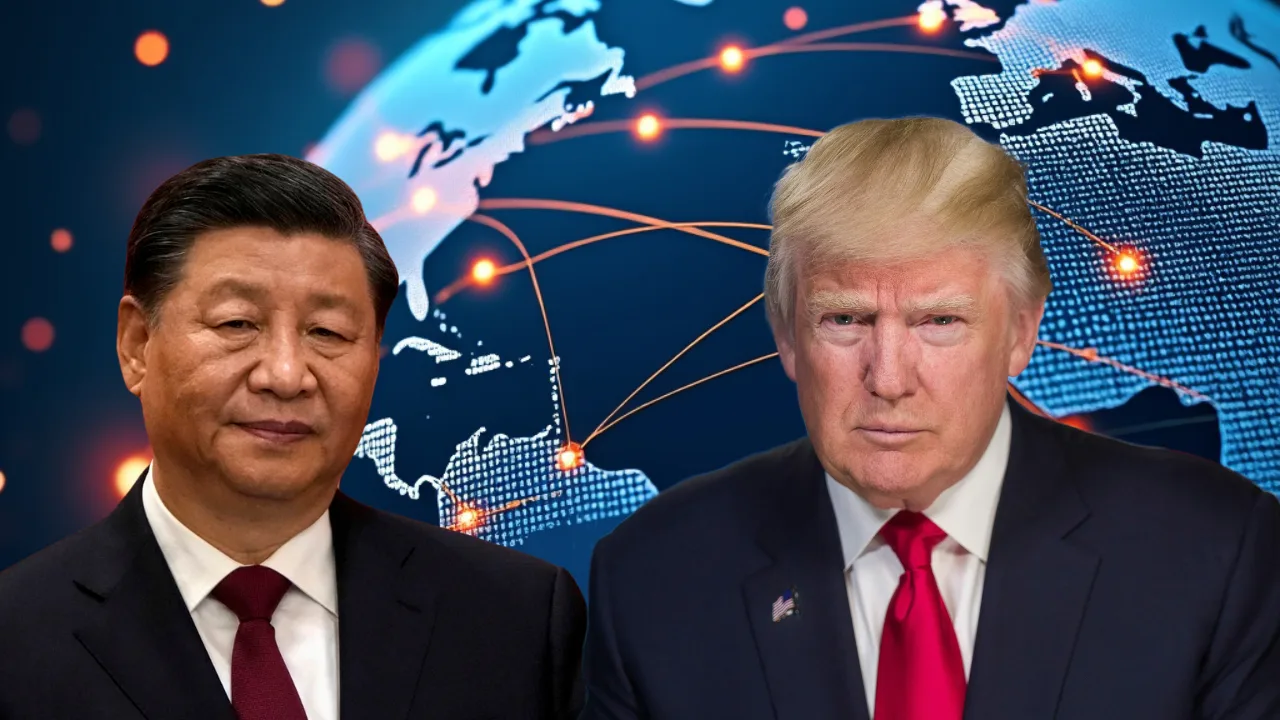
The global artificial intelligence (AI) landscape is shifting—fast. In a bold and strategic move, China unveiled a comprehensive global action plan for AI on Saturday, only days after the United States announced its own AI roadmap under President Donald Trump. The timing and content of China’s announcement underscore its ambition to lead—not just compete—in the AI revolution.
As the U.S. and China take divergent paths in shaping the future of AI, the implications for investors are profound. This isn’t just about geopolitics or technology—it’s about where capital will flow, which companies will rise, and which nations will dominate the next generation of innovation.
China’s AI Push: A Global Strategy
Premier Li Qiang announced the action plan at the World Artificial Intelligence Conference (WAIC) in Shanghai, a state-sponsored gathering aimed at showcasing China’s AI ambitions. According to the official readout, China is calling for the establishment of a global AI cooperation organization, seeking to foster international collaboration in AI development and governance.
The plan is part of what Li called China’s “AI Plus” strategy—an initiative to integrate artificial intelligence across all sectors of its economy, from manufacturing and finance to healthcare and agriculture. The goal? To position China as a central force in shaping global AI standards and application models.
Li also emphasized China’s willingness to share AI technology with developing nations, especially those in the so-called Global South. This could allow China to deepen influence among countries participating in its Belt and Road Initiative, adding a tech dimension to its infrastructure and trade diplomacy.
“China clearly wants to stick to the multilateral approach while the U.S. wants to build its own camp, very much targeting the rise of China in the field of AI,” said George Chen, partner at the Asia Group and co-chair of its digital practice.
The U.S. Response: A Decoupled Approach
President Trump, just days earlier, announced the American AI Action Plan, a sharply different strategy that focuses on supporting domestic innovation and combating perceived ideological bias—what the administration calls “woke” programming—in AI systems. The U.S. plan also encourages deployment of American-made AI abroad, but through alliances with like-minded democracies, such as Japan, Australia, and select European partners.
The result: two very different AI governance models are now being defined. China’s model emphasizes state-led, globally inclusive development, particularly focused on the Global South. The U.S. model emphasizes free-market innovation, intellectual property protection, and ideological guardrails aligned with Western values.
In effect, the AI world is bifurcating—into a China-led bloc and a U.S.-led bloc.
Schmidt in Shanghai: A Curious Presence
Adding another layer of intrigue to the Shanghai conference was the presence of former Google CEO Eric Schmidt. According to an official city announcement, Schmidt met with Shanghai Party Secretary Chen Jining just ahead of the conference. While a representative for Schmidt declined to comment, the meeting highlights the ongoing dialogue—public or private—between top Western tech figures and Chinese officials.
Schmidt, who has been vocal about America’s need to maintain AI leadership, has also expressed admiration for China’s pace of innovation. His presence raises questions about whether some U.S. tech leaders are hedging bets as the global AI power map evolves.
Semiconductor Tensions Remain
A critical backdrop to this AI rivalry is the battle over semiconductors—the raw compute power needed to train and deploy AI models. Since 2022, the U.S. has placed heavy restrictions on China’s access to advanced chips, particularly those made by Nvidia.
However, this month, Nvidia resumed shipments of a downgraded H20 chip to China, after a three-month pause due to export controls. This chip, while not as powerful as those used in U.S. military and research applications, is still capable of training significant AI models.
Meanwhile, China has doubled down on developing domestic alternatives. Nvidia CEO Jensen Huang, who recently visited China for the third time this year, acknowledged the progress. “China’s homegrown chips are formidable,” he said, acknowledging that the tech war has motivated rapid innovation inside China’s borders.
Why This Matters for Investors
The implications of this emerging AI bifurcation are enormous—not just for tech companies, but for entire portfolios. Here’s what investors should be watching:
1. Global Tech Supply Chain Realignment
As China and the U.S. build separate AI ecosystems, global supply chains will splinter. Western firms may be forced to choose between the U.S.-aligned and China-aligned markets, especially in sectors like semiconductors, cloud infrastructure, and quantum computing.
Investment Insight: Companies like Taiwan Semiconductor Manufacturing Co. (TSMC), ASML, and Samsung could see both new opportunities and heightened risk as demand patterns shift and political pressures mount.
2. Emergence of New AI Powerhouses
As China expands its “AI Plus” plan, investors can expect rising stars from within its tech ecosystem—particularly among state-backed firms focused on natural language processing, robotics, surveillance, and smart city tech.
Investment Insight: Firms like iFlytek, SenseTime, and Baidu (especially its Ernie Bot project) are poised to benefit from state support and international partnerships.
3. Regulatory Divergence
The U.S. and China are pursuing different AI regulatory philosophies. The U.S. is leaning toward more private-sector control with guardrails on content bias and safety. China, by contrast, is developing centralized guidelines with a focus on “beneficial AI” aligned with national priorities.
Investment Insight: Expect compliance costs to rise for global firms operating across borders. U.S.-based multinationals may need to firewall operations in China or exit certain markets altogether.
4. Geopolitical Risk as a Market Force
The growing tech cold war is creating real volatility in global markets. Any policy announcement—be it export restrictions or AI investment bans—can move stock prices overnight.
Investment Insight: Investors should monitor sectors like cybersecurity, defense, and sovereign data infrastructure. ETFs that track these themes, such as the Global X Cybersecurity ETF (BUG) or the WisdomTree Artificial Intelligence ETF (WTAI), may benefit from this evolving environment.
China’s Playbook: Long-Term Vision, Global Influence
What sets China’s AI plan apart is its long-termism and soft-power strategy. By offering AI tools to developing nations and advocating for multilateral cooperation, China is playing the long game—building allies, setting norms, and ultimately shaping the global AI governance structure.
This is similar to how China approached its Belt and Road Initiative: use state-driven investments to create dependency, goodwill, and strategic leverage. Only this time, the infrastructure being built isn’t roads and bridges—it’s neural networks, datacenters, and governance frameworks.
The AI Iron Curtain?
We may be witnessing the early stages of an AI iron curtain—two incompatible AI worlds, each with its own chips, codebases, data norms, and strategic partners. For investors, that means choosing sides may no longer be optional.
While the U.S. leads in foundational model innovation, China is moving faster on implementation and global adoption. And in a world where data is oil and algorithms are weapons, speed and scale could matter more than ideology.
Smart investors will be watching not just earnings reports and chip sales, but speeches in Shanghai, legislation in Washington, and handshakes in the Global South.
Sources:
- Reuters: Nvidia resumes chip shipments to China
- South China Morning Post: Li Qiang’s WAIC address
- Bloomberg: Eric Schmidt’s role in U.S. AI policy
About Author